Lake District National Park: Acoustic Biodiversity Monitoring Case Study
15 October 2025
Continuous Bird Monitoring in the Lake District National Park
In August 2025, we deployed our first continuous acoustic monitoring station in the Lake District National Park, operating 24/7 from LDNP offices near Kendal. The goal was to demonstrate what automated species detection can deliver compared to traditional survey methods and to build a baseline species record for the surrounding habitat.

The Challenge
Traditional bird surveys rely on trained ecologists visiting a site a handful of times per year, typically during dawn chorus windows. This approach is expensive, weather-dependent, and inherently limited. A few hours of human observation can only ever capture a snapshot. For national parks managing vast, ecologically diverse landscapes, this leaves significant gaps in species data. National Parks have various projects where they require monitoring for BNG requirements, nature recovery or general biodiversity tracking, so demonstrating this kind of technology has a lot of value to those who work there.
Hardware and Deployment
The monitoring station is built around a Raspberry Pi 5 with a high-quality USB microphone. This deployment uses a wired connection from the LDNP offices, drawing on their mains power and wired internet. A simple installation that does not require solar, battery, or 4G infrastructure. This makes it a low-maintenance, always-on system that can easily be monitored without specialist technical knowledge.
How the Data Is Captured
The station runs BirdNET-Go, analysing audio continuously in 3-second clips and matching vocalisations against a neural network trained on thousands of bird species. Each detection is logged with:
- Species identification with a confidence score
- A spectrogram of the vocalisation
- A saved audio clip for manual review and verification
This means every detection is auditable, so staff can listen back, verify identifications, and flag false detections. This data is equally valuable for refining future deployments, allowing us to adjust the software’s detection parameters to maximise true identifications and minimise false positives.
BirdNET-Go also provides a live web portal where detections stream in as they happen, alongside charts and summaries that break down species activity by time of day, date, and confidence level.
Results - Eight Months of Continuous Monitoring
Updated 1st June 2026
Since beginning operation in August 2025 up to April 2026, the system has been recording an average of 15,000-20,000 detections every month, with over 60 different species detected. Peak activity falls during dawn chorus (5am–8am), consistent with known avian behaviour patterns. It has been interesting to see the activity of different birds rise and decline depending on the time of year and we’re currently preparing a more detailed seasonal breakdown to share publicly.
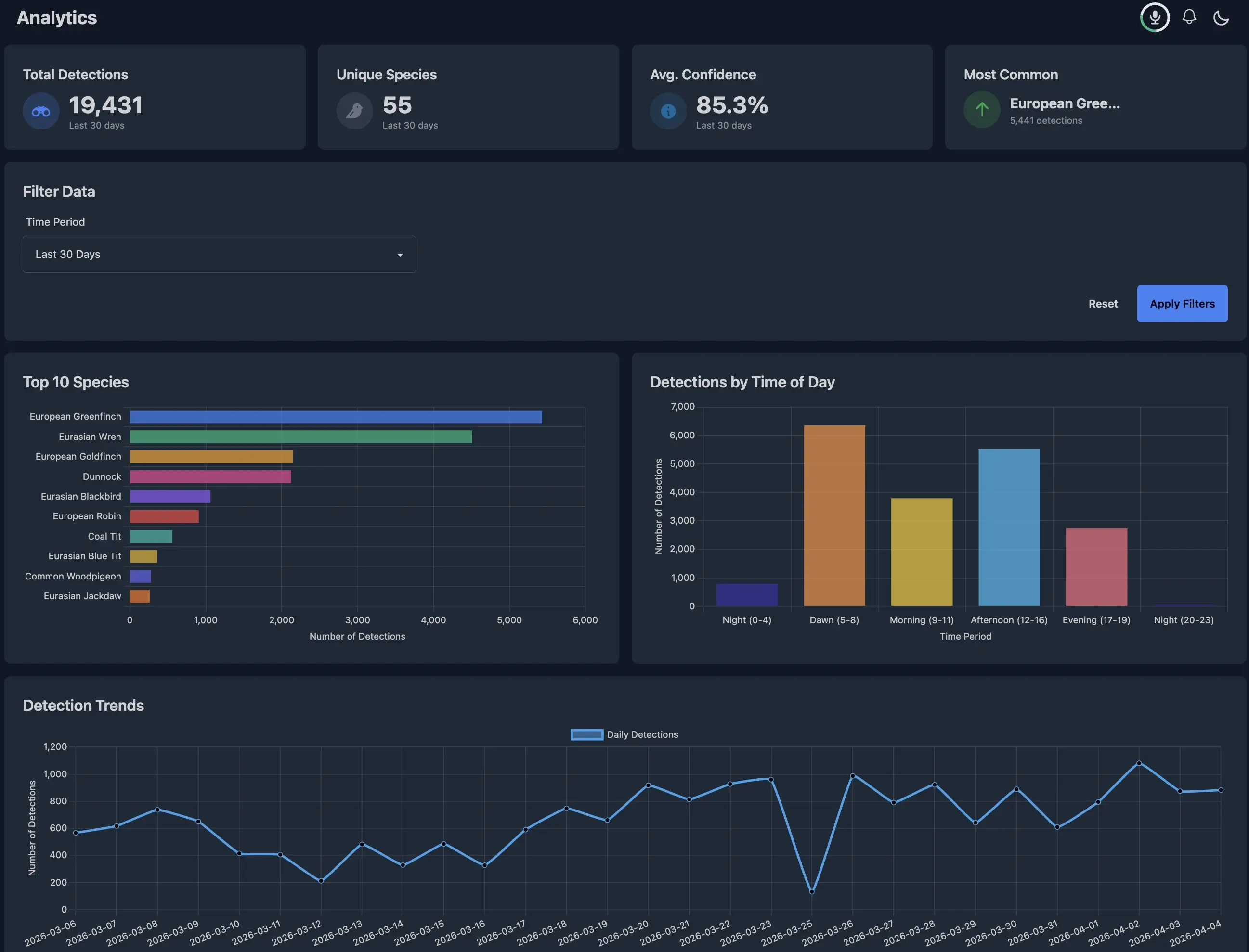
This volume of data captured automatically around the clock, across all weather conditions, is a big step up from what periodic manual surveys can deliver. A single ecologist’s visit might record 15–25 species in optimal conditions; this system captured many more species continuously, including nocturnal and crepuscular vocalisations that manual surveys routinely miss.
We have since installed two further monitors in different Lake District locations. As of August 2026, the detections from all three are published on the Lake District National Park Authority’s own Live Bird Call Detection page, where anyone can explore them - we wrote about that here.
What This Means for Land Managers
For national parks, nature reserves, and rewilding projects, continuous acoustic monitoring provides:
- Baseline species inventories built over weeks and months, not extrapolated from a handful of site visits.
- Seasonal trend data that tracks how species composition shifts across the year. Essential for habitat condition assessments.
- Verifiable, auditable records suitable for Biodiversity Net Gain reporting, Local Nature Recovery Strategies, and grant evidence.
- Real-time visibility for staff, without needing to wait for an ecologist’s report.
What’s Next
We are tracking how species composition changes as the seasons shift - watching for winter migrants, changes in dawn chorus timing, and how detection patterns correlate with habitat and weather conditions. We will share updated analysis as the dataset grows.
If you manage a protected landscape and want to explore what continuous acoustic monitoring could add to your biodiversity evidence base, get in touch.