Four Free Apps to Help You Learn About and Protect Biodiversity
1 December 2025
Most of us probably don’t need more screen time, and it’s important to recognise that we all connect with nature differently. If you prefer to enjoy nature in pure silence without the urge to identify everything you see, that is wonderful. Likewise, if you love to learn but prefer the tactile feel of a physical book or the company of a knowledgeable friend, you should absolutely embrace that.
However, for those who would value a small helping hand from technology, this is for you. Hopefully these suggestions not only save you time searching for the right app, but also inspire you to get outdoors and learn more about the environment around you.
The UK is currently one of the most nature-depleted countries on earth and much of the knowledge we used to have of the natural world that surrounds us has been lost through generations. By re-discovering this knowledge, we can move from being passive observers to active protectors of our local biodiversity. Identifying a specific bird call or a rare fungus can help us understand how habitats function. And once you start noticing what’s there (and what’s missing), it’s easier to care and to help, even in small ways.
Here are four free apps that will help you identify what’s around you next time you’re out in nature.
1. Merlin Bird ID (identify birds by sound, sight, or simple questions)
Of course this would be our first choice! It’s built by the Cornell Lab of Ornithology, who we love for many of their creations, including the open-source BirdNET software. Merlin allows you to identify birds on the move a few different ways: answer a couple of questions, upload a photo, or use Sound ID, which listens and suggests likely species in real time. Merlin draws on huge datasets (including eBird and the Macaulay Library), which is why it can be impressively accurate in supported regions.
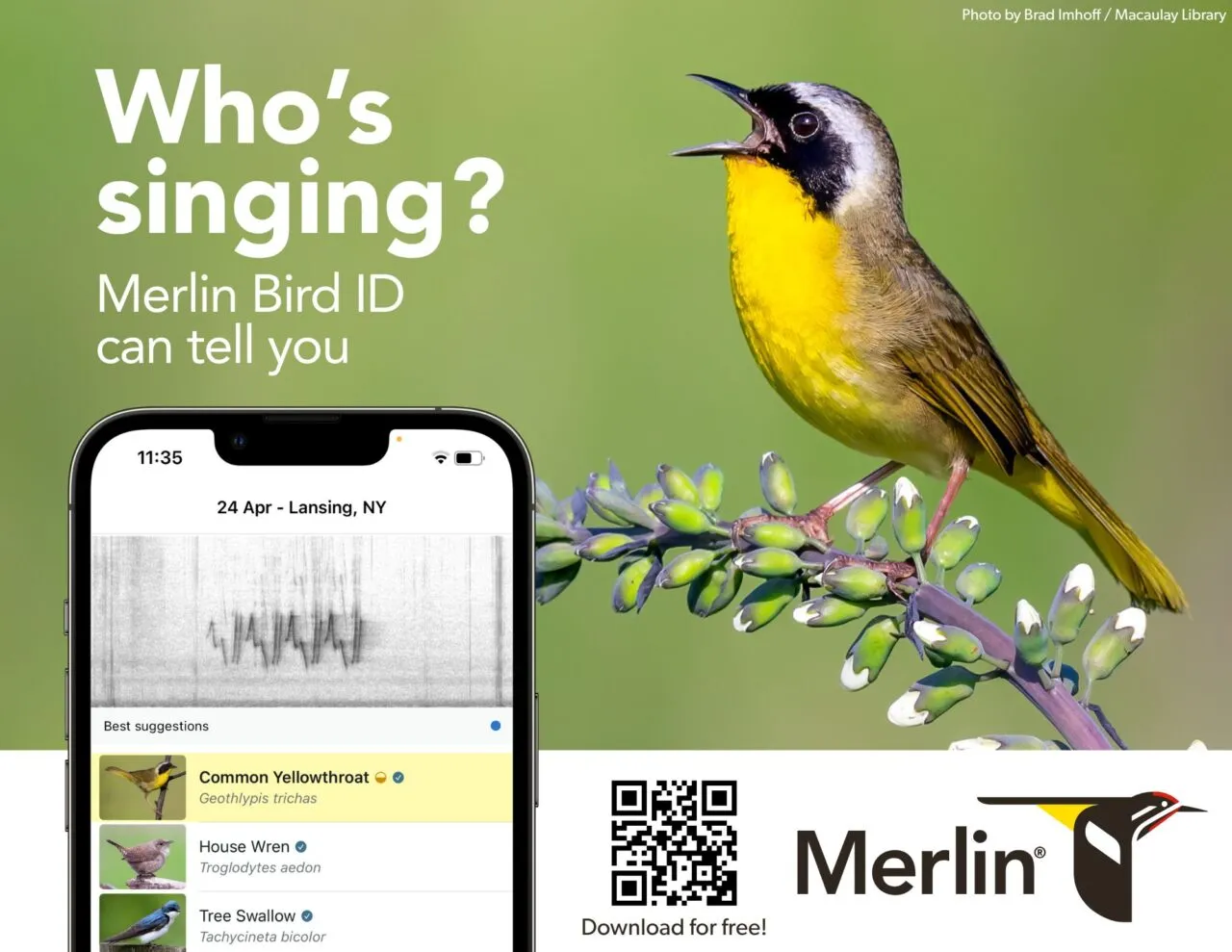
I found Merlin after researching bird acoustics and have found it extremely useful in helping confirm bird species from their song when I’m out and about in dense woodland or hiking a mountain. It can be useful to get to know different species in each habitat (wood edge, open field, riverside). You can save your IDs and compare later and if you use it regularly, you’ll start noticing patterns by place and time.
Site: https://merlin.allaboutbirds.org/
2. Picture Mushroom (identify fungi)
Fungi are one of the easiest ways to make autumn (or any damp month) feel magical, but they can also be very difficult to identify. Picture Mushroom lets you take or upload a photo and returns likely matches along with useful context like habitat and lookalikes.
Important to remember that these apps can be wrong, especially with mushrooms that look similar. Hence this is definitely an app to use with caution - don’t go eating something you find solely based on what Picture Mushroom says!
Pro-Tip: When you open the app, it may appear as if you need to pay, so you need to click the ‘X’ in the top right to close the pop-up and you can then ID your mushrooms for free.
Site: https://picturemushroom.com/app
3. Pl@ntNet (identify plants)
Pl@ntNet focuses on plant identification from photos and is also built as a citizen-science project, so by using it you’re contributing to a global map of plant biodiversity used by researchers worldwide. This is my go-to app when I want to ID a plant. You simply photograph a key feature on the plant (eg. leaf, flower, or overall plant) and the app suggests likely species. I’ve found this one extremely accurate and useful for both identifying plants in the garden to confirming species when out foraging in the woods.
Site: https://plantnet.org/en/
4. iNaturalist (identify almost anything - and contribute to real biodiversity data)
iNaturalist is part field guide, part community, part citizen-science tool. You upload an observation (usually photos), get help with identification (from both AI suggestions and real people), and your sightings can contribute to biodiversity science and conservation.
I find this one great in helping identify insects, or just to log interesting things you find and help contribute to their data. Make sure you add location and date accurately, as those details matter for ecology. You can also follow local projects or places to see what others are finding nearby.
Site: https://www.inaturalist.org/
Ultimately, these apps are tools to help us rebuild our own knowledge. The goal is that we need them less and less as we go and eventually are able to pass that wisdom down to the next generation without the need for a screen at all.