Urban vs Rural: How Bird Vocal Patterns Shift
12 June 2026
The strange data that led us to this study
During a recent check on a bioacoustic monitor we have positioned in an urban environment, we noticed some very odd patterns of bird behaviour. First, we noticed that redwings were being detected throughout the night, which seemed odd. We then noticed wrens were up in the darkness and singing their dawn chorus as early as midnight. Initially, we suspected the model settings may have led to incorrect detections, but we played back the audio recordings and confirmed the detections were genuine. This led us to look back through more historic data for other anomalies, and to run a direct comparison against rural data so any differences would be clear.
Bird vocal activity is shaped by a daily rhythm, driven by different factors such as light, temperature, food availability, acoustic conditions and predation risk. In a “natural” rural setting, most diurnal songbirds follow a fairly predictable pattern: A strong dawn chorus, followed by a mid-morning tail, a quiet middle of the day, and often a smaller dusk peak.
Urban environments can change almost every variable in that list, leading to city birds having very different habits, and the charts below offer a localised snapshot of the kinds of shifts ecologists have reported. It’s worth keeping in mind that this is a comparison of two specific bioacoustic monitors, not a population-level study, so we’d treat these as suggestive patterns rather than proof of any universal urban rule.
The Data
We analysed just over 6 months’ worth of data, from 25th September 2025 to 17th April 2026. During these dates, over 224,000 detections were recorded in total across both monitors. All detections were generated by BirdNET, the open-source acoustic classifier developed by the Cornell Lab of Ornithology and Chemnitz University of Technology, running locally at each site on continuous audio via the BirdNET-Go platform.
Average bird vocal activity across all species (Rural)
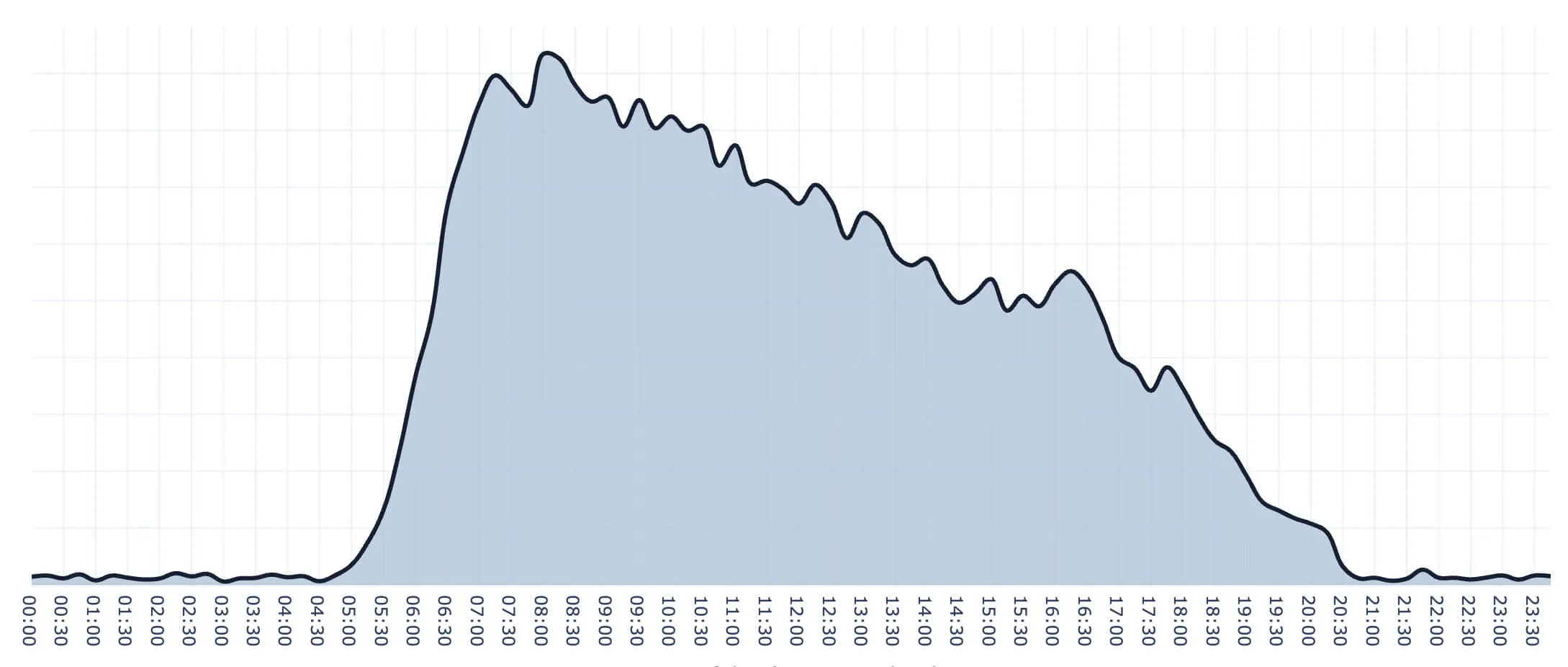
Looking at the average activity throughout the day in the rural location, you can see it broadly matches what we would expect. There’s a little activity before dawn and after dusk, but with 2,961 owl detections in this period, that’s almost entirely owls. Take them away and the night is essentially silent.
Average bird vocal activity across all species (Urban)
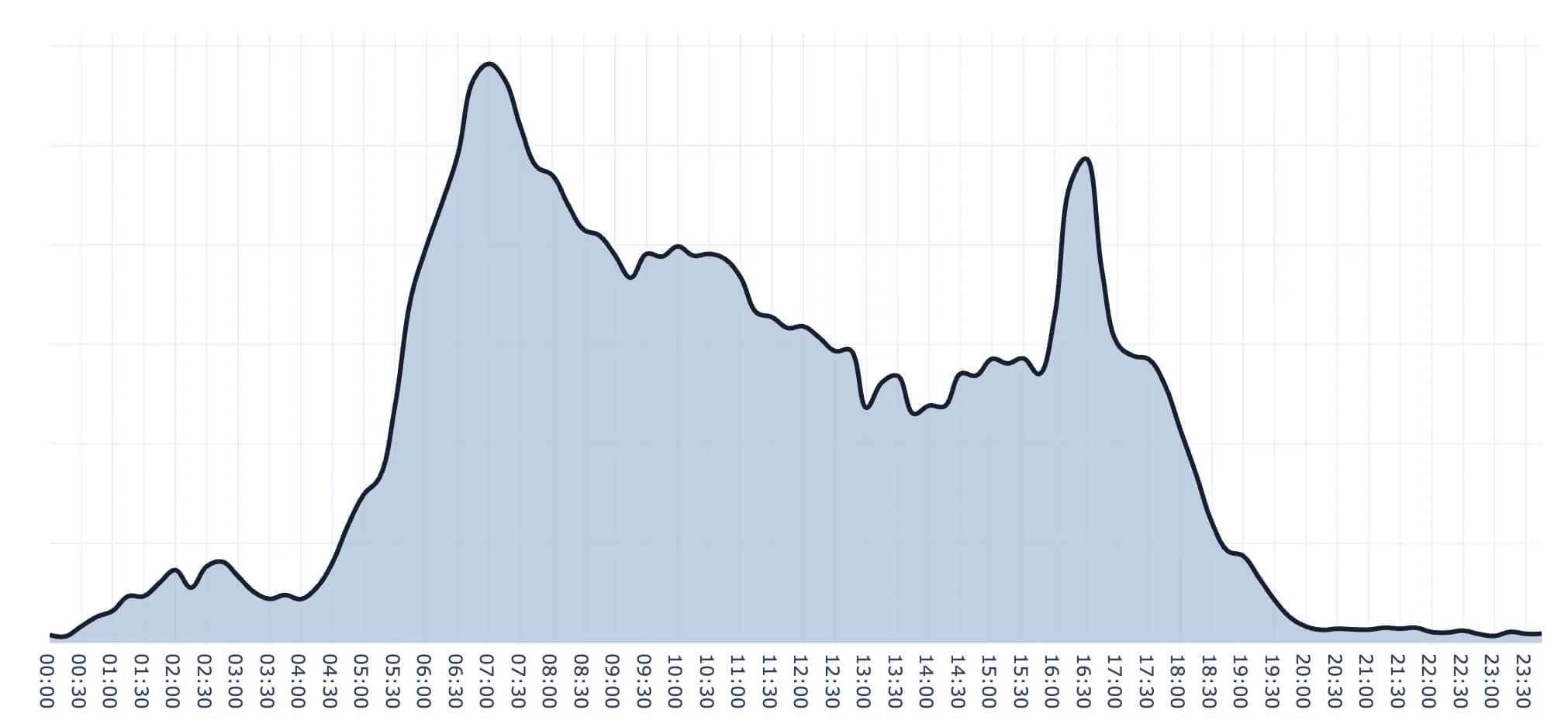
In contrast to the rural location, the dusk peak here is significantly more pronounced. This likely reflects the higher population of robins and blackbirds, who drive the dusk chorus. Notice the activity after dusk and especially before dawn is much higher here. This is not due to owls as in the rural location.
Shifted or extended activity
Redwing
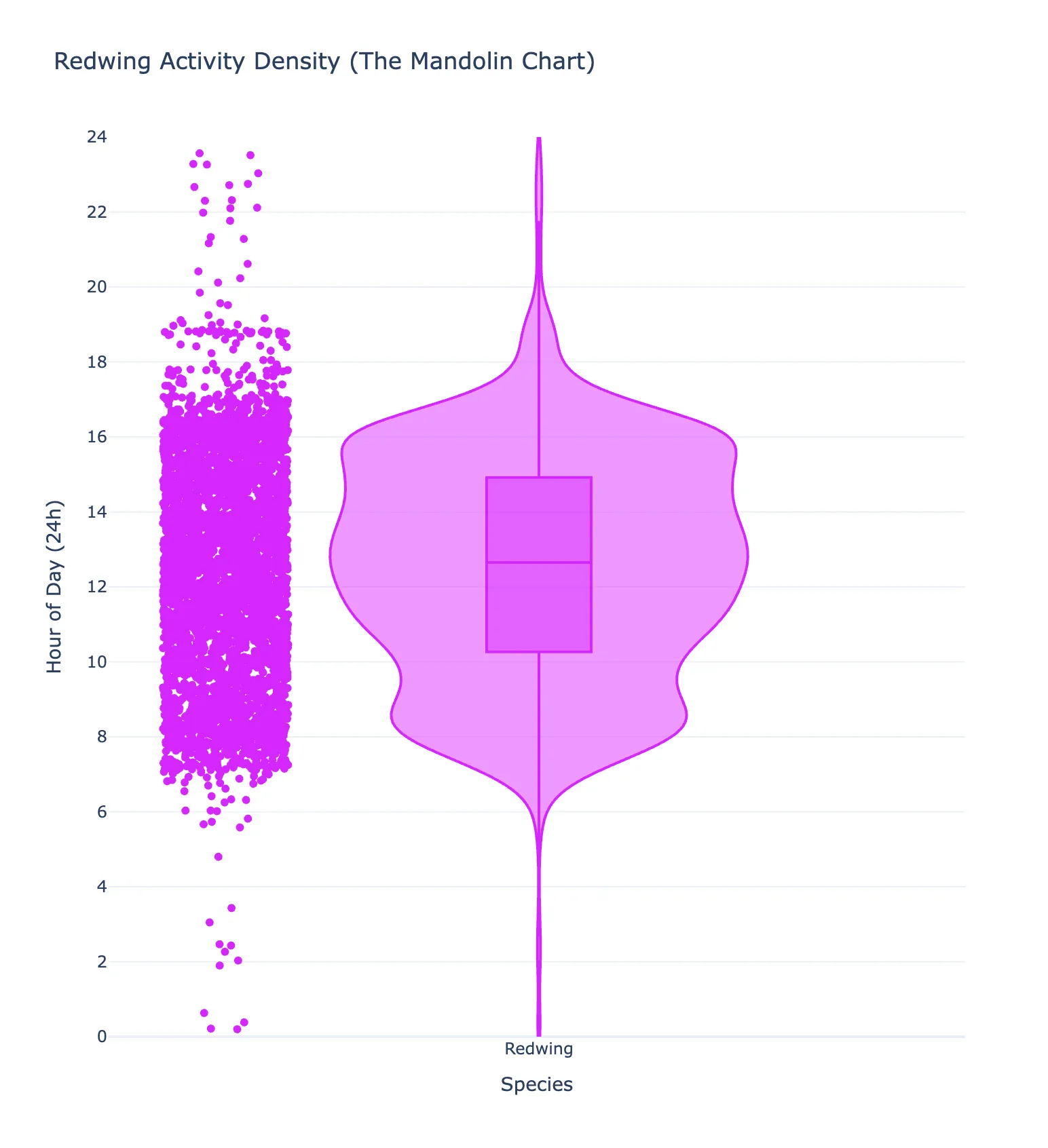
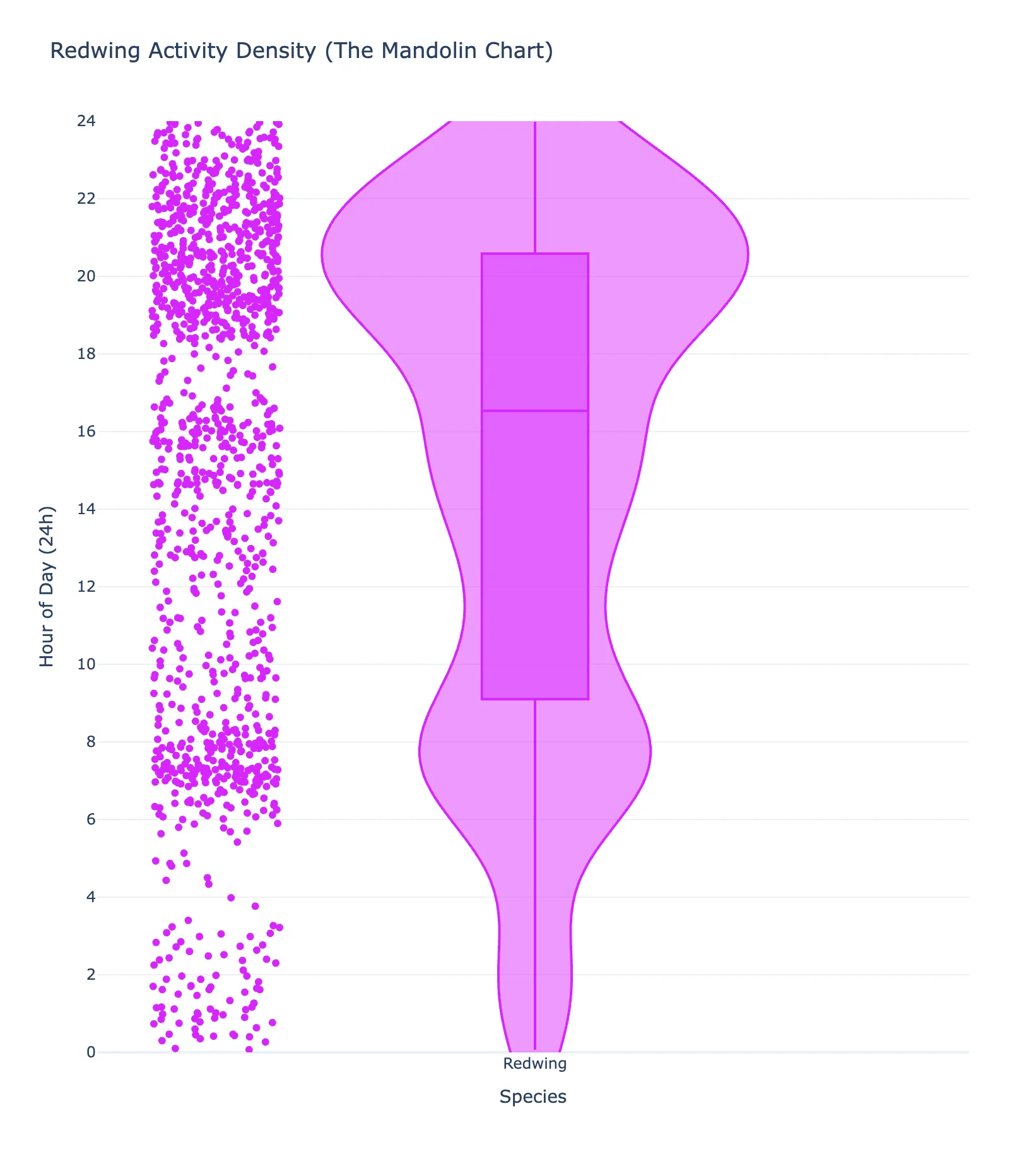
Let’s start with the bird that triggered our investigation, where the urban-rural difference is immediately visible. Redwings are nocturnal migrants, often heard calling “seep” as they pass overhead at night during autumn and spring migration. They’re also active during the day, foraging in flocks on berry-laden trees and open fields, so a rural recorder typically picks up daytime feeding calls along with a thin scatter of overhead flight calls at night - exactly the pattern visible on the left.
The urban chart shows something very different. Activity is spread across most of the 24-hour cycle, with a heavy concentration through the evening and the early hours of the morning, with dense detections continuing right through to dawn. Listening back through the urban recordings, most detections sounded like birds perched in nearby trees rather than passing high overhead. This points to phototaxis - the phenomenon where city light acts as a beacon to night-migrating birds (much like you see with moths around a streetlamp). Migrants get drawn down from their high-altitude flight paths, become disoriented by the glow, and end up landing in the nearest “island” of green - a garden tree, a park, a roadside hedge. Once landed, they continue calling to other migrants as they try to re-orient themselves, often wasting vital energy circling lit areas.
The handful of overnight detections on the rural chart are likely birds doing what they’re supposed to do: calling briefly while passing high overhead. Urban areas with light pollution are well known to disorient and concentrate nocturnal migrants, and the fact that urban monitors pick up far more nocturnal flight calls than rural ones is well-documented. Citizen science projects like Nocmig specifically exploit this effect.
Earlier dawns and nocturnal song
The Robin, Blackbird and Eurasian Wren are shoulders above the rest, with all three species showing earlier dawn activity in the urban data. There are two main drivers:
-
Light pollution ALAN (Artificial Light at Night) is known to be the main reason for earlier dawn starts. There is a large multi-species study on this by Da Silva, Valcu and Kempenaers [1], which tracked dawn and dusk singing across many European songbirds in relation to light exposure.
-
Anthropogenic noise Traffic noise rises sharply between 6am and 8am in cities. Birds that need to broadcast territorial song shift earlier to find a quieter acoustic window. Some birds also sing louder and at a higher pitch to compete with low-frequency traffic noise (The Lombard Effect).

The wren was the best example of this, as seen in the comparison below. Rural wrens have a clean dawn start around 5am, peak activity through the morning, and quiet by sunset. By contrast, the urban wrens are detected singing from midnight onwards, often launching into intense song bouts at 1am or 2am, hours before any other songbird is up.
Eurasian Wren
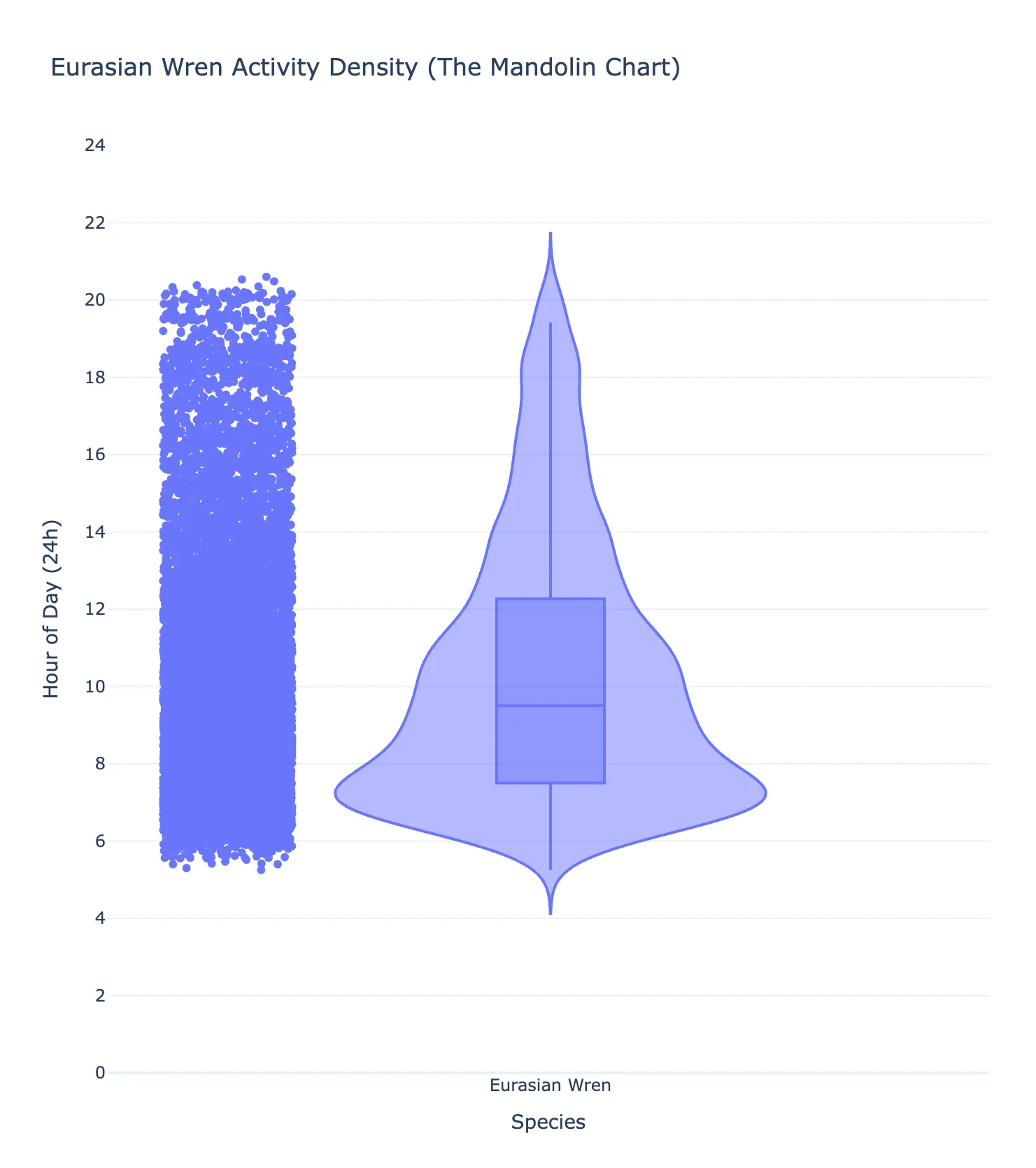
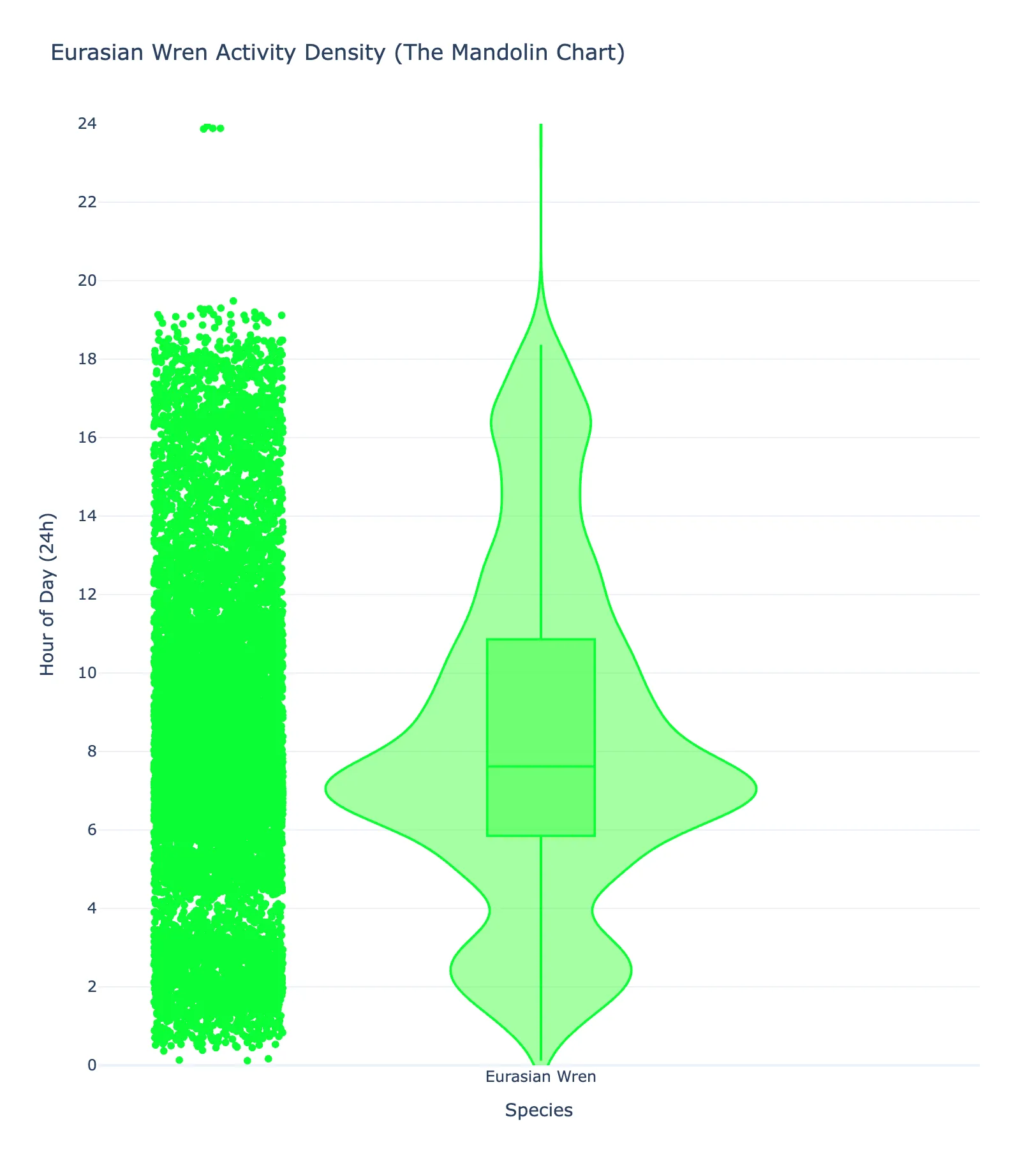
What surprised us most isn’t just that they shift earlier, but that on many spring nights they are essentially the only bird singing. Meanwhile the blackbirds and even the robins (the most famous nocturnal singers) barely registered. From February to April, the wren is consistently the earliest and most prolific pre-dawn vocaliser across our urban data.
Urban wren detections across the season
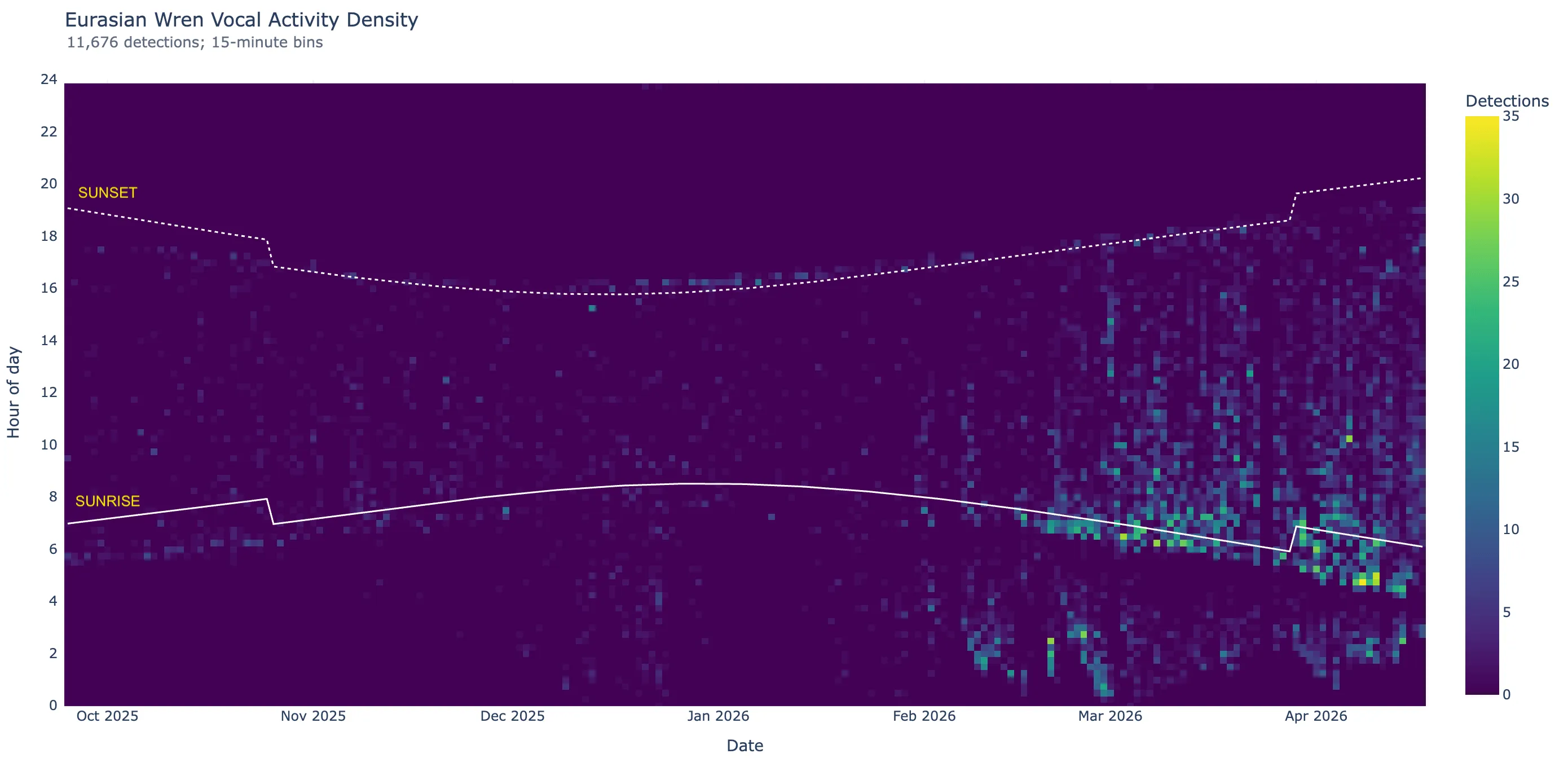 Each cell = 15-minute window, brighter = more detections.
This is genuinely unexpected. The Da Silva et al. paper mentioned above found that a species’ response to ALAN is closely linked to eye size. Larger-eyed species are more light-sensitive at low light levels, so detect the artificial “false dawn” earlier and shift their song accordingly. On that basis, wrens should be among the least affected: they have small eyes, are naturally later starters in the dawn chorus, and lack the low-light sensitivity of robins and blackbirds. However, our data shows the opposite.
The most likely explanation might be that we’re picking up the behaviour of one or two unusually vocal males rather than a population-wide shift. Wren song is loud and delivered in long, structured bouts, and a single male in peak territorial mode can rack up impressive detection counts on his own. Even so, the behaviour itself (a wren singing intensely from midnight in early spring) doesn’t appear to be well documented, and is interesting in its own right. March and April are peak territorial season for wrens (a polygynous species, with males building multiple “cock nests” to attract several females), and the pre-dawn hours offer essentially uncontested acoustic space: no traffic, no rival species, and sound carrying further in the still, cool air. A male who claims that window may be exploiting a real urban-only advantage. One final observation is that after their early shift hours before sunrise, they do seem to take a nap for an hour or two before joining the dawn chorus.
We’ve since had informal feedback from a researcher working on urban bird ecology that nocturnal wren singing has been anecdotally observed elsewhere in the UK, so we will continue to gather data around this finding and we’d be curious to hear whether anybody else has noticed similar patterns. Please get in touch if so!
European Robin
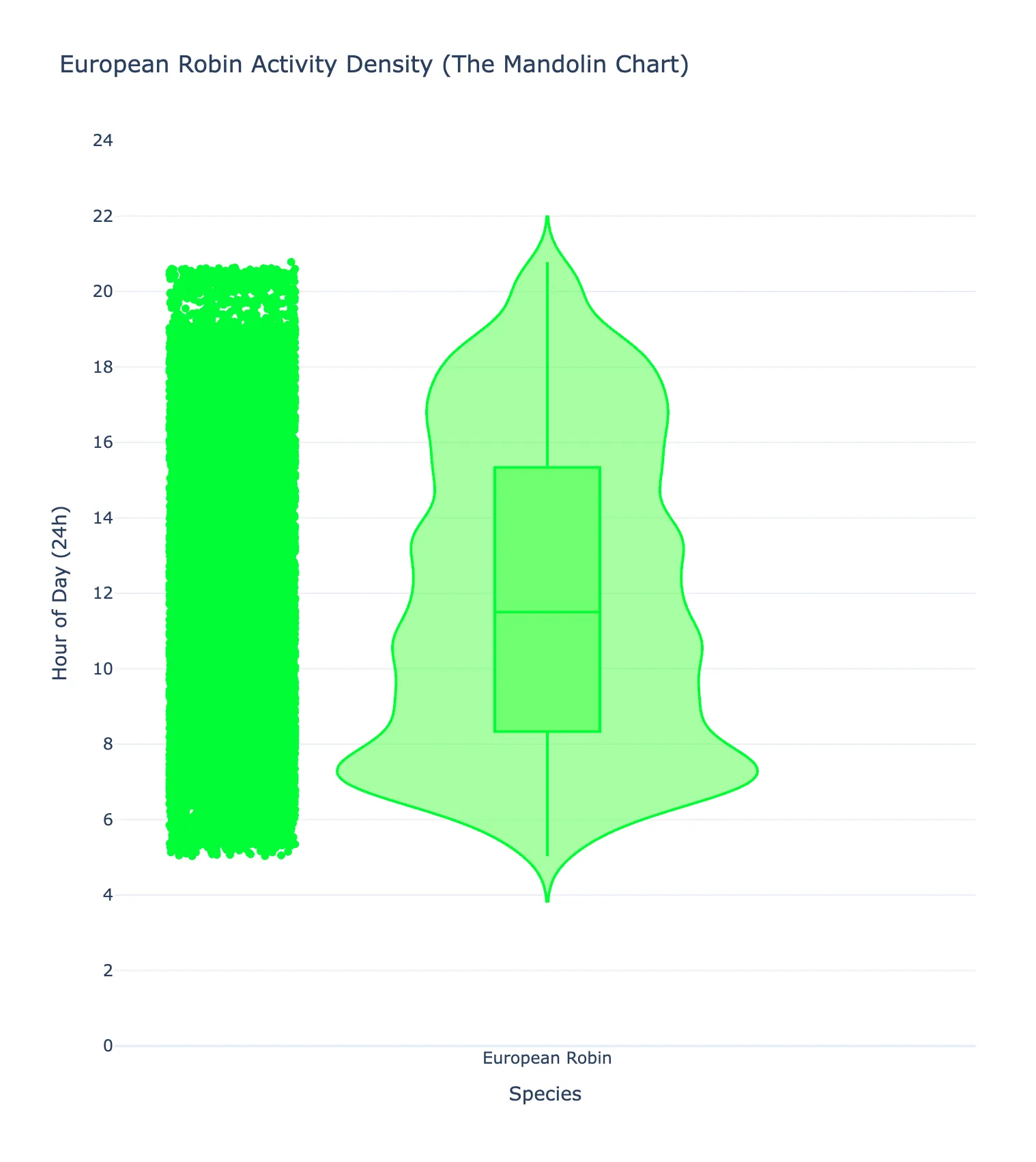
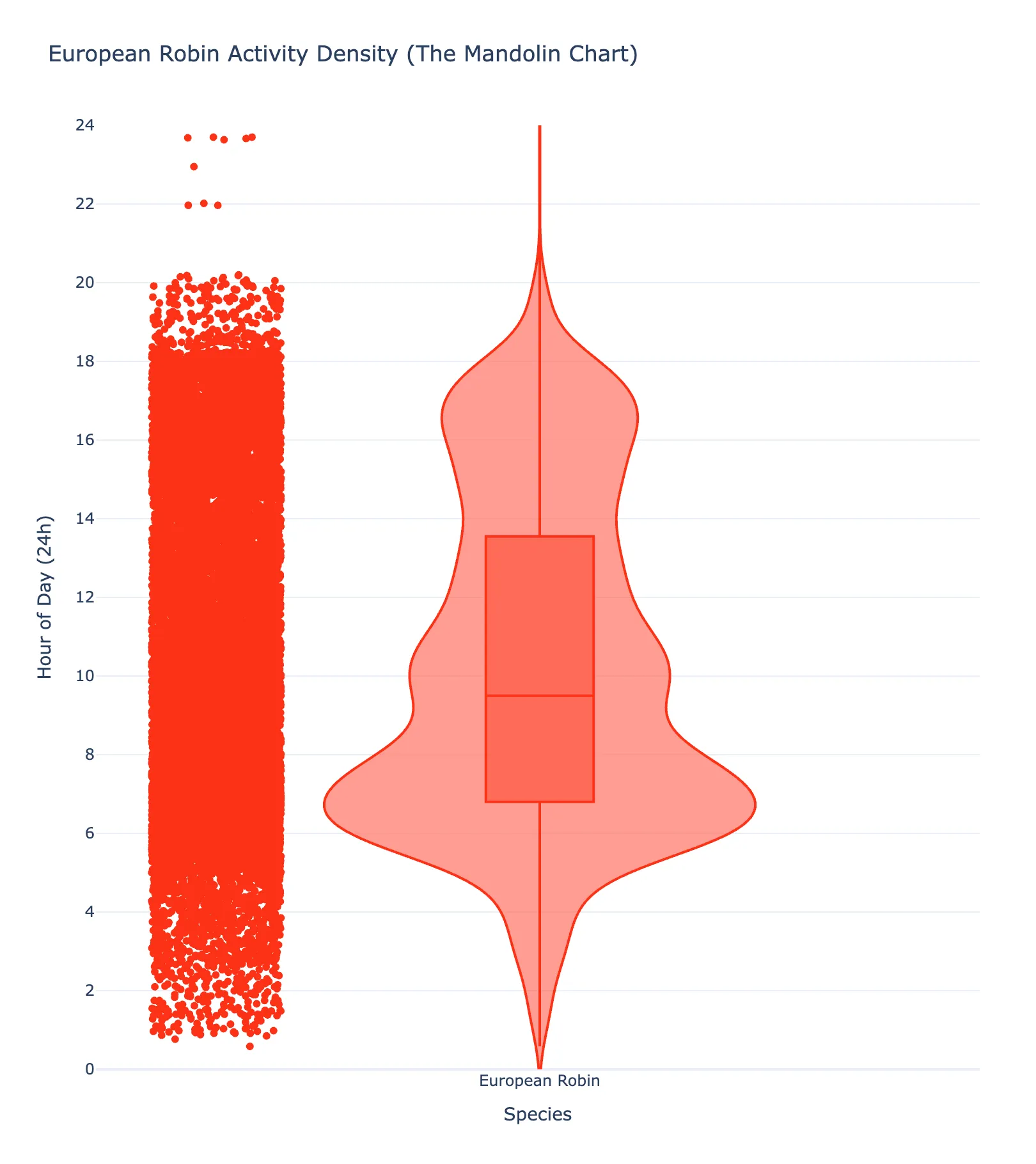
Robins are another species that are very clearly affected by the urban environment. Notice the rural robins have a single mid-morning hump, with all detections for the day fitting neatly into a 5am-9pm window. The urban robin on the other hand has a bimodal pattern, with many robins up and singing well before dawn.
This is a heavily studied urban bird phenomenon, and robins are famous for singing at night under streetlights. While the intuitive trigger is artificial light at night (ALAN), Fuller, Warren and Gaston’s [3] influential Sheffield study reframed this behaviour as a clever workaround for daytime noise. They found that where daytime traffic was loud, robins shifted to the quiet of the night to ensure their territorial songs could actually carry to rivals and mates.
Subsequent urban ecology work suggests light and noise rarely act in isolation. ALAN may act as a physiological trigger, while noise provides the acoustic pressure to use the quieter hours. The likely picture is that nocturnal robin song in cities is driven by both, with the balance shifting depending on the specific conditions of each street corner.
Eurasian Blackbird
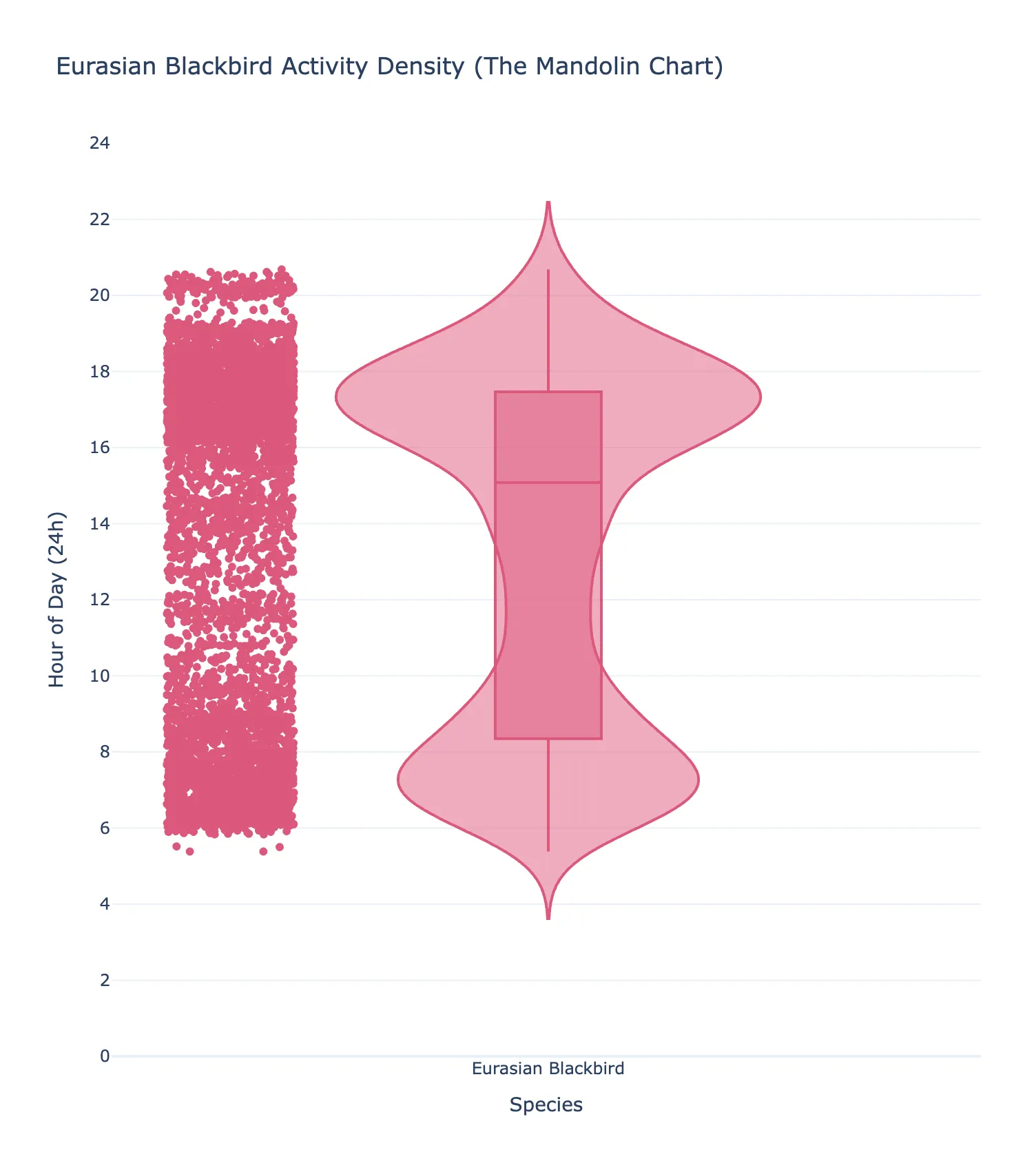
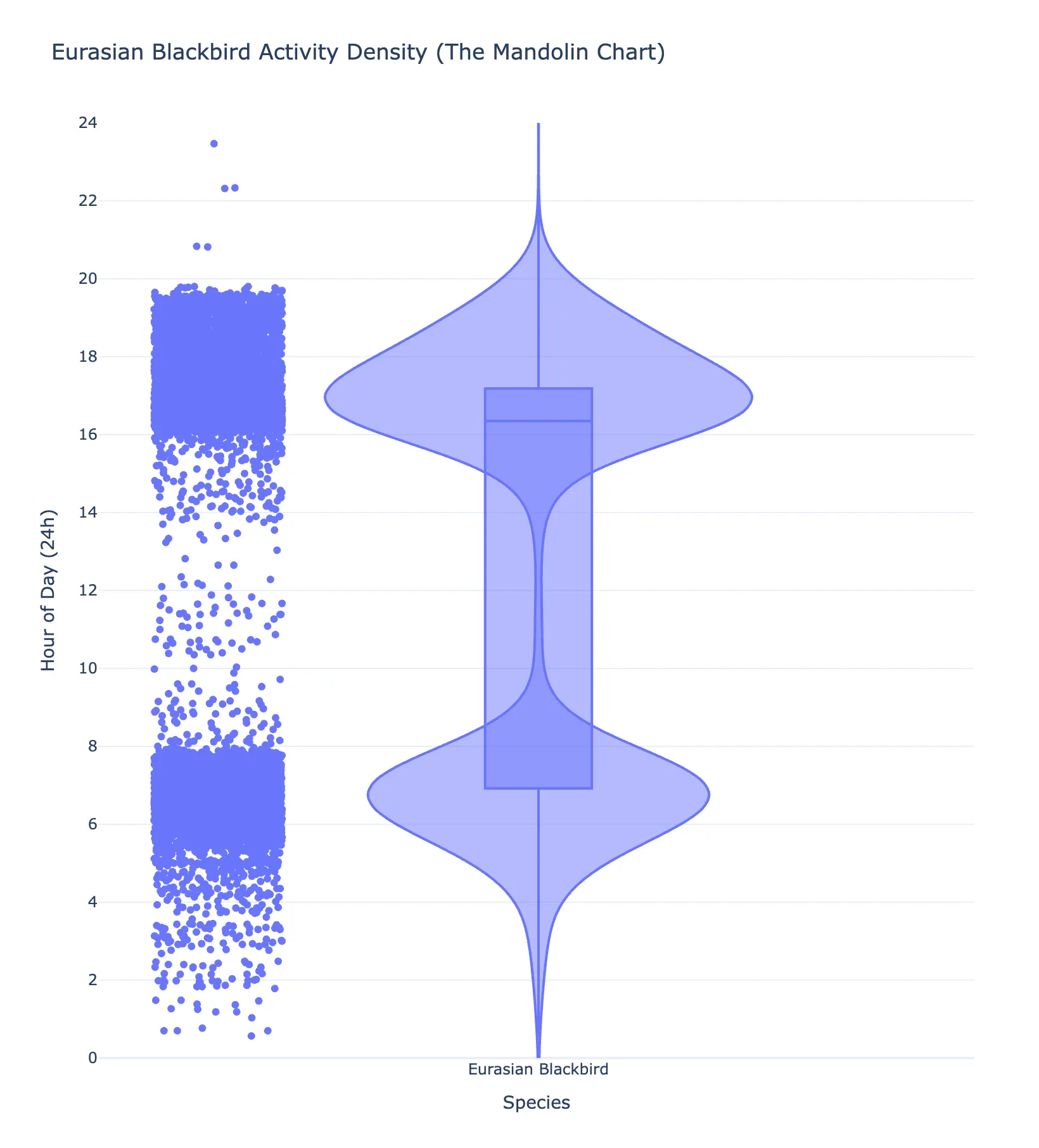
Once again, you can notice a fairly big difference in the charts here. Rural blackbirds tend to sing within a neat window roughly 6am to 9pm, whereas the urban blackbirds start much earlier in the night, from around 1am and intensifying around 5am.
The shift from afternoon-skewed (rural) to strongly bimodal dawn/dusk (urban) is very typical for an urban blackbird. They are among the most-studied urban adapters; city blackbirds have been shown to start singing 30+ minutes earlier than forest blackbirds, sing at higher pitches, and concentrate effort at dawn and dusk to avoid the noisy middle of the day. They are also known to start breeding up to three weeks earlier in urban environments, due to artificial light triggering their hormonal cycles, along with warmer city temperatures.
For a deeper dive, see Nordt & Klenke (2013), “Sleepless in Town – Drivers of the Temporal Shift in Dawn Song in Urban European Blackbirds” (PLOS ONE), which documents the dawn-shift pattern almost exactly as it appears in our data [2]
Eurasian Jackdaw
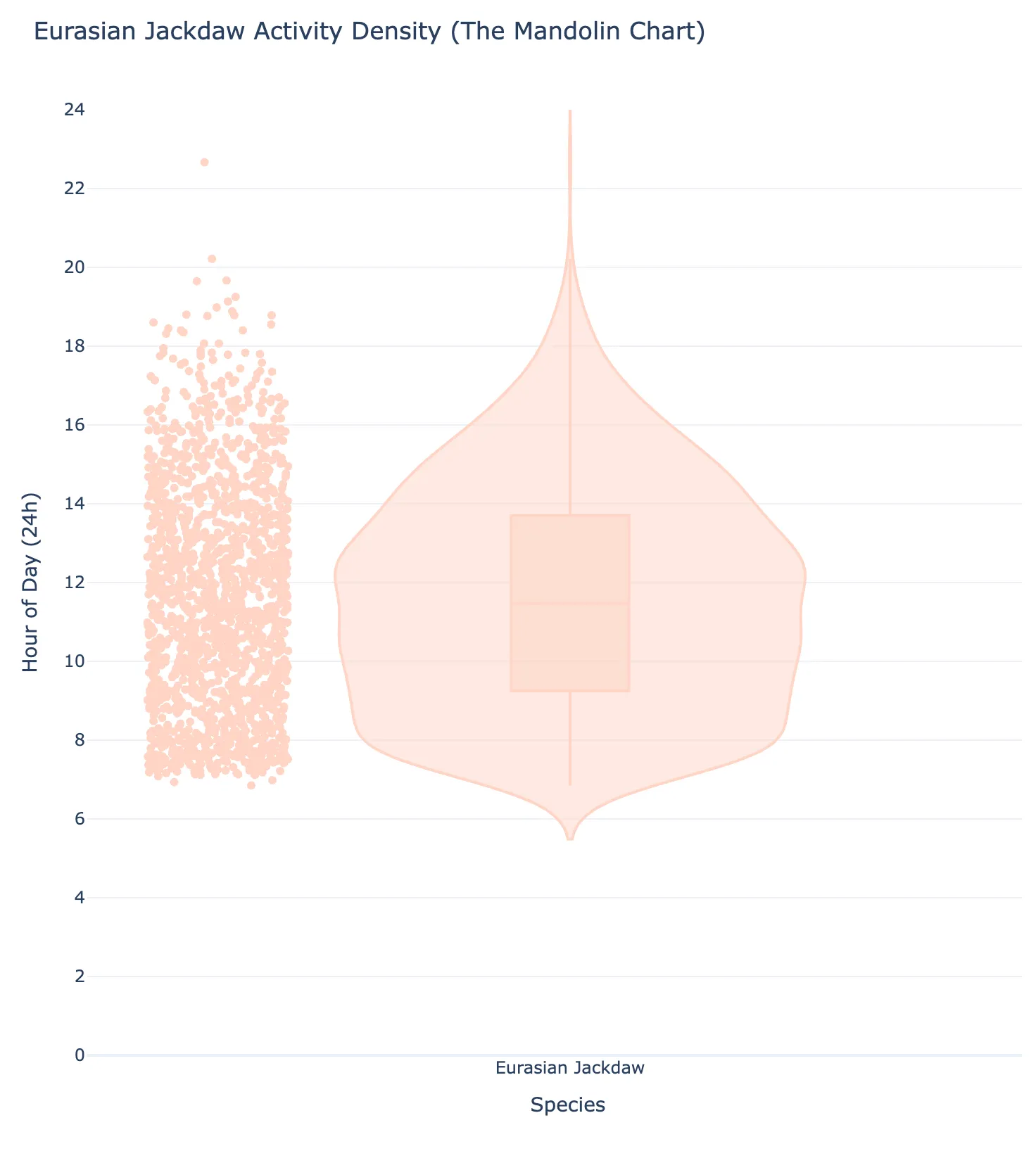
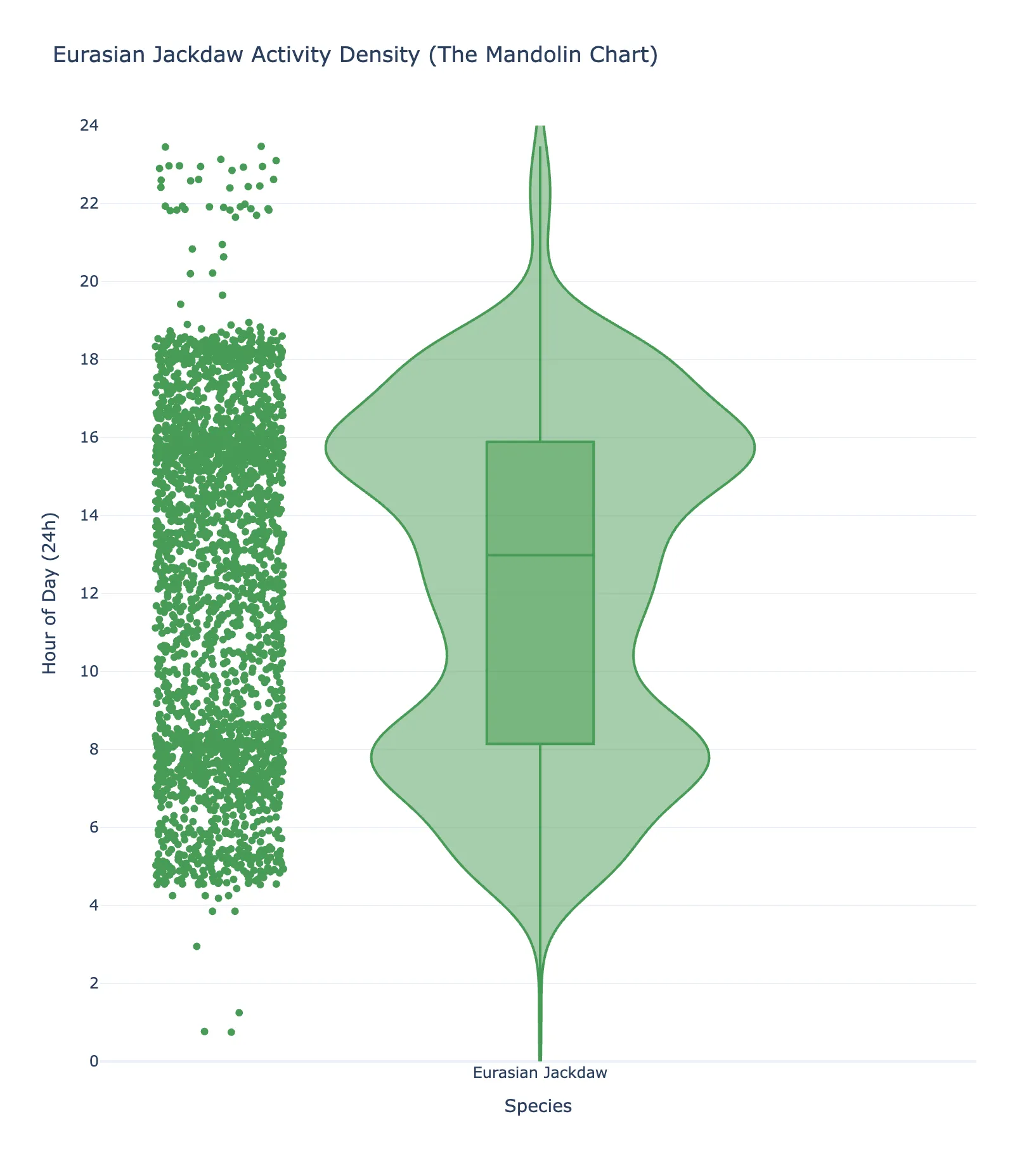
The rural jackdaws have a typical pattern for a corvid: they leave roosts at dawn, forage actively through the morning, then quiet down. The urban birds have a very different activity pattern: they are up much earlier, most active between 2pm and 4pm, with a long tail running toward midnight. The afternoon peak likely reflects opportunistic foraging around predictable human routines (school playgrounds emptying, bin collection, evening food waste), and the late-evening activity points to street lighting extending their working day past natural dusk.
Species with little change
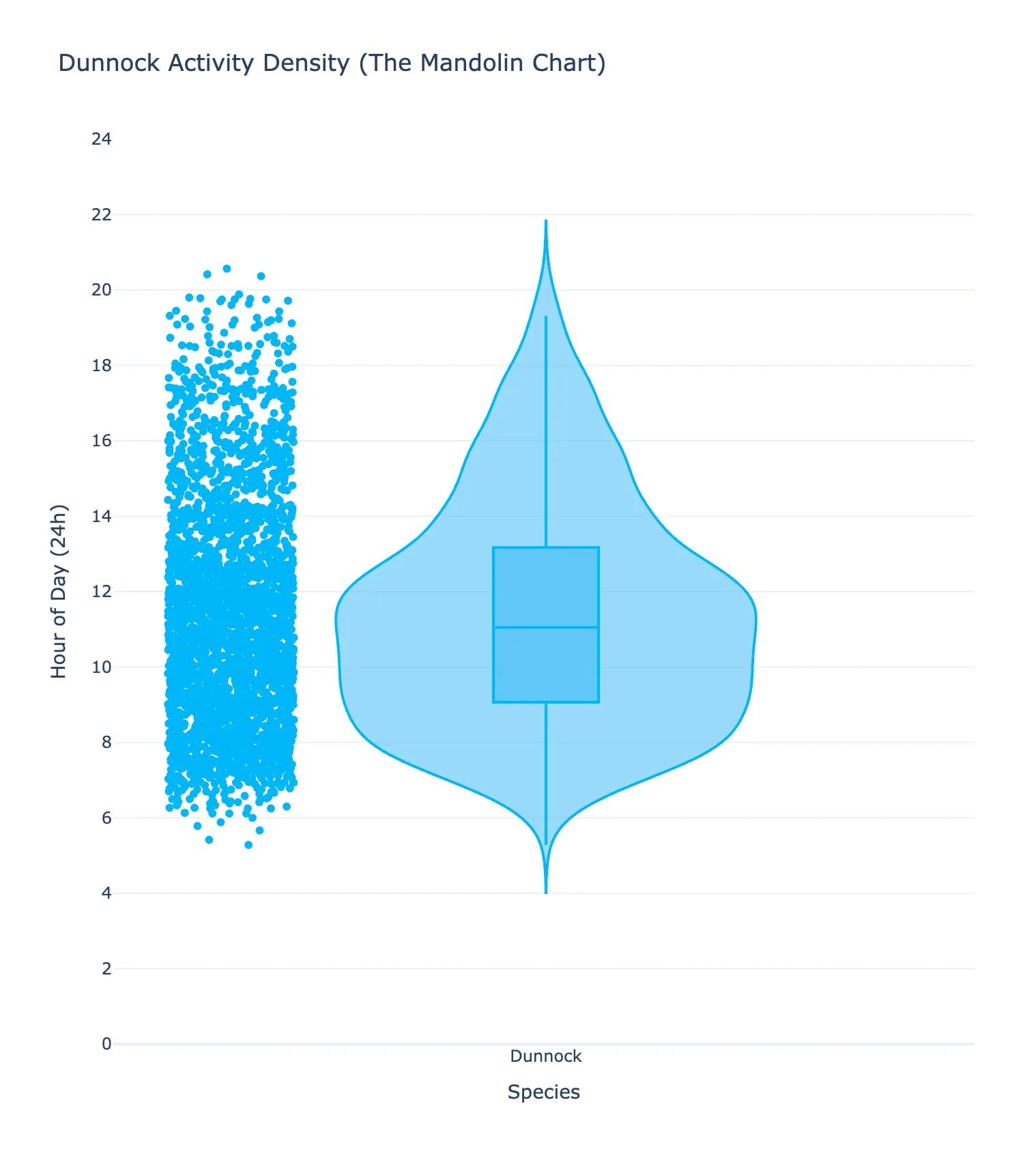
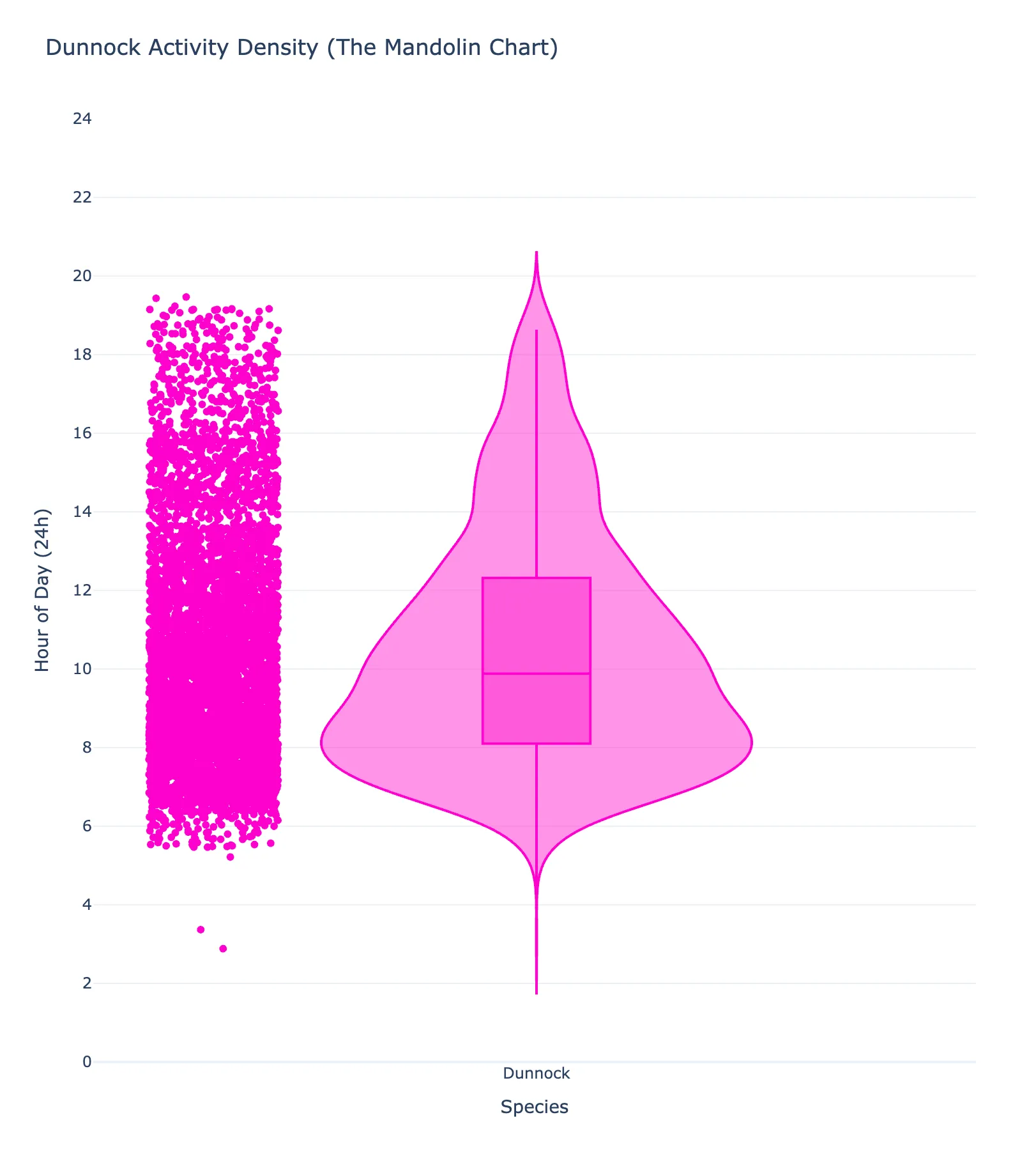
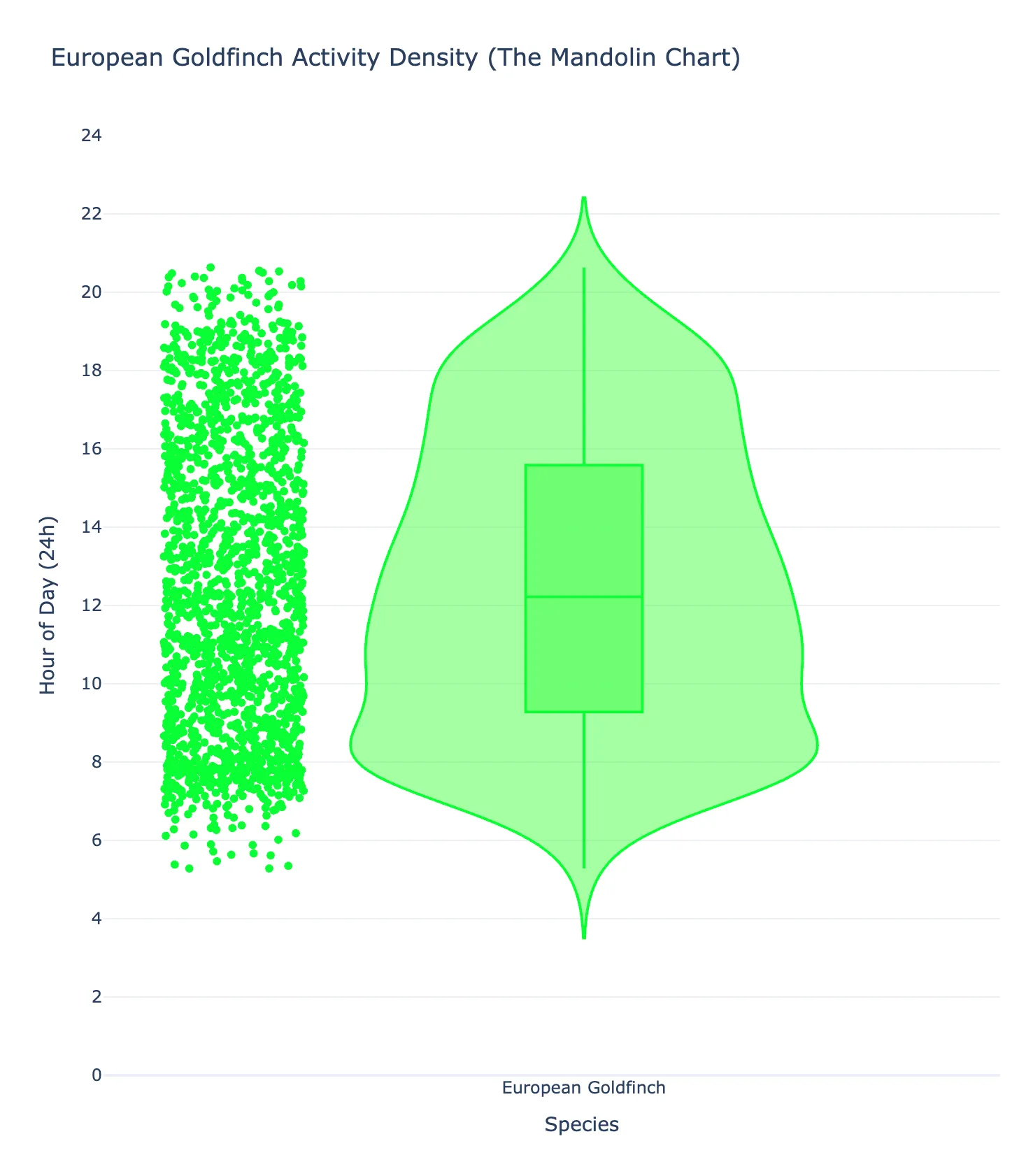
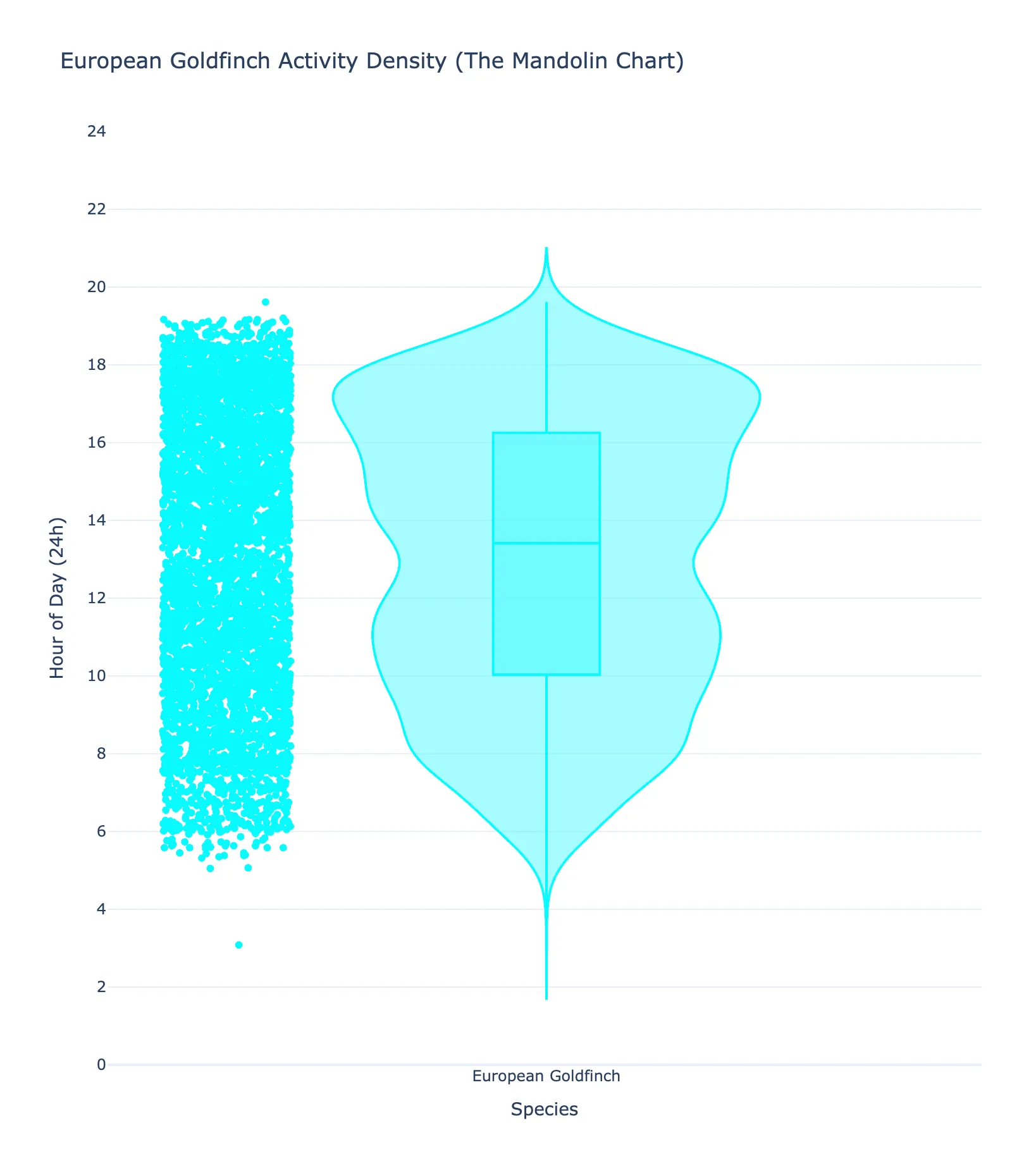
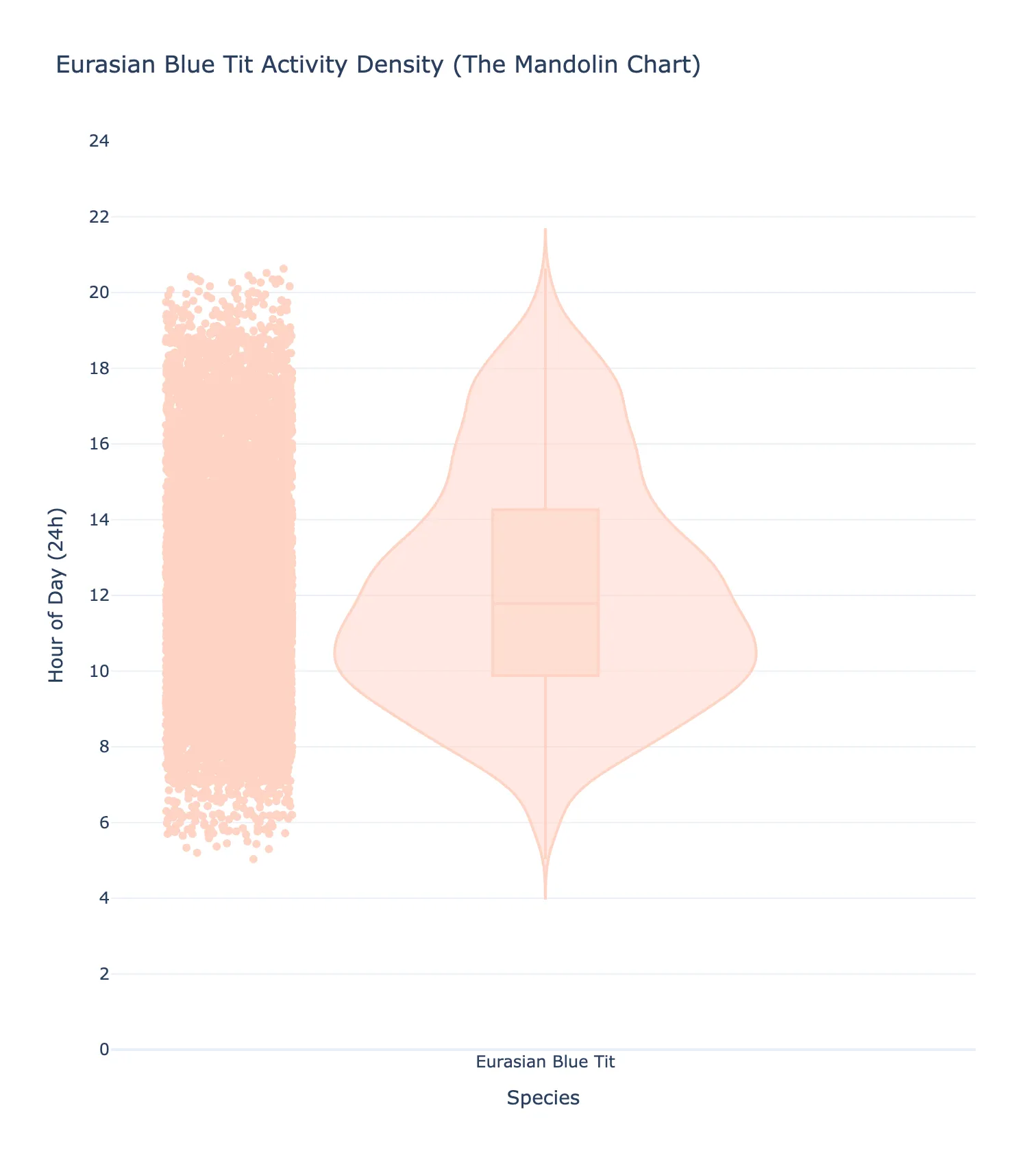
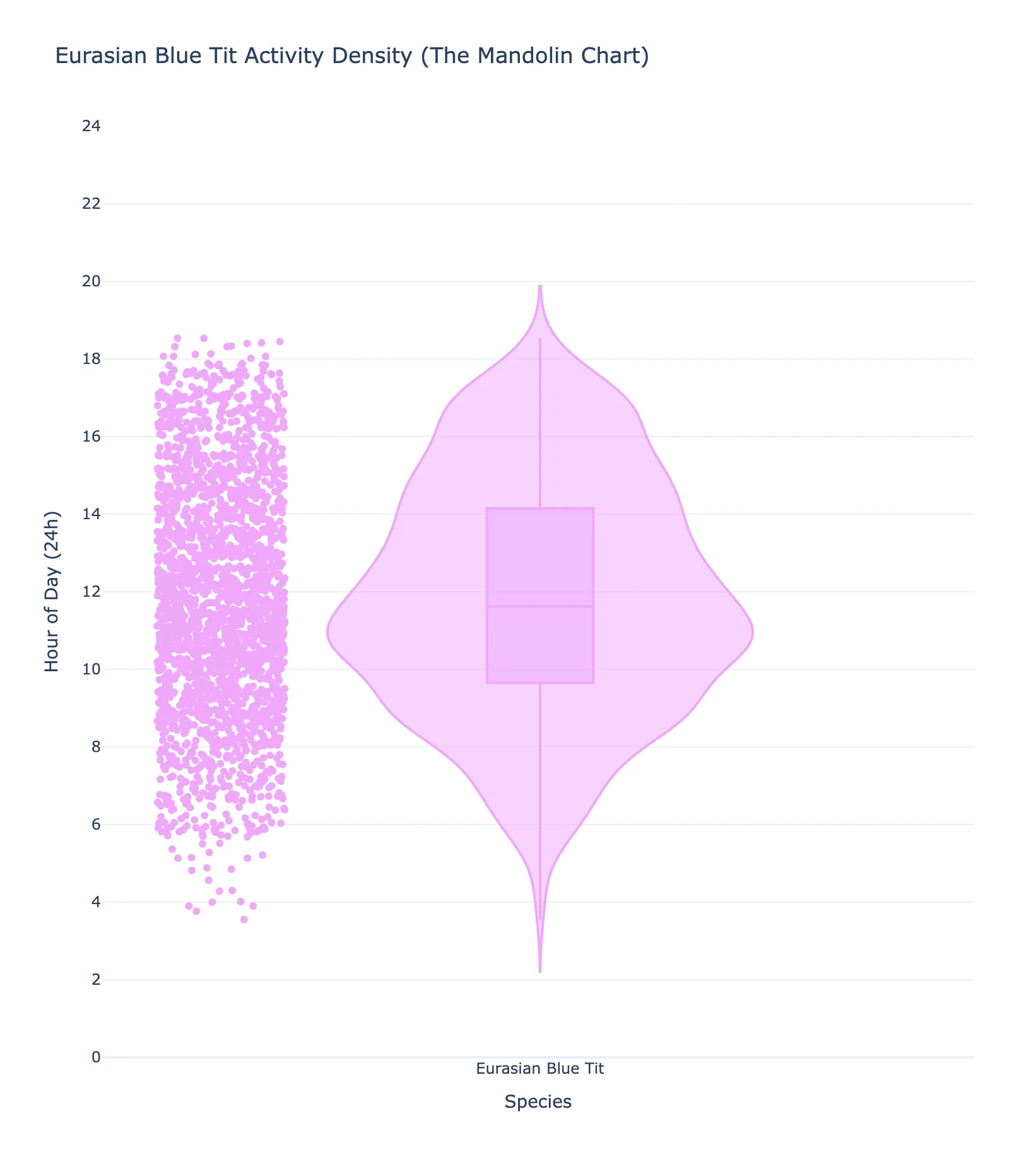
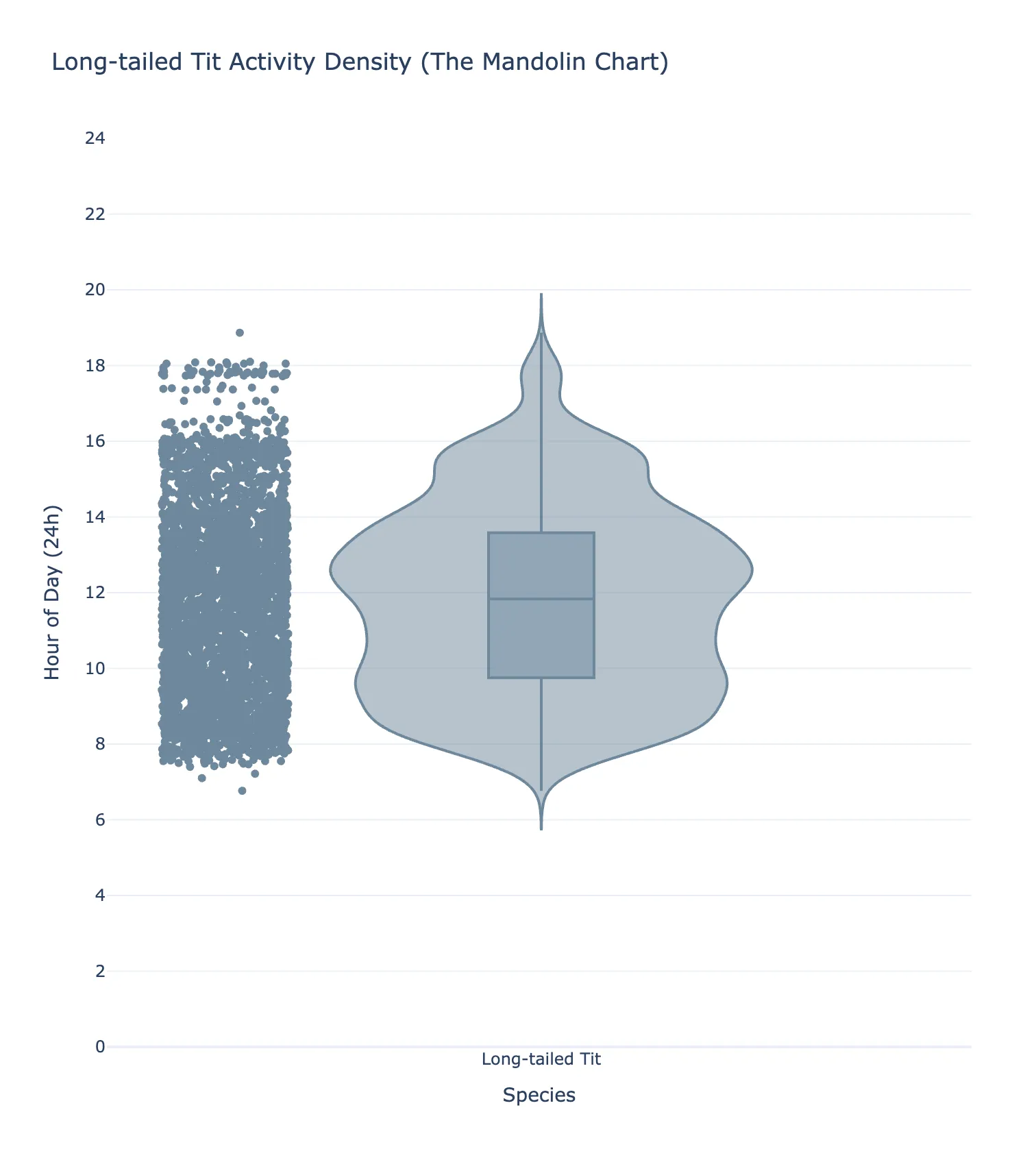
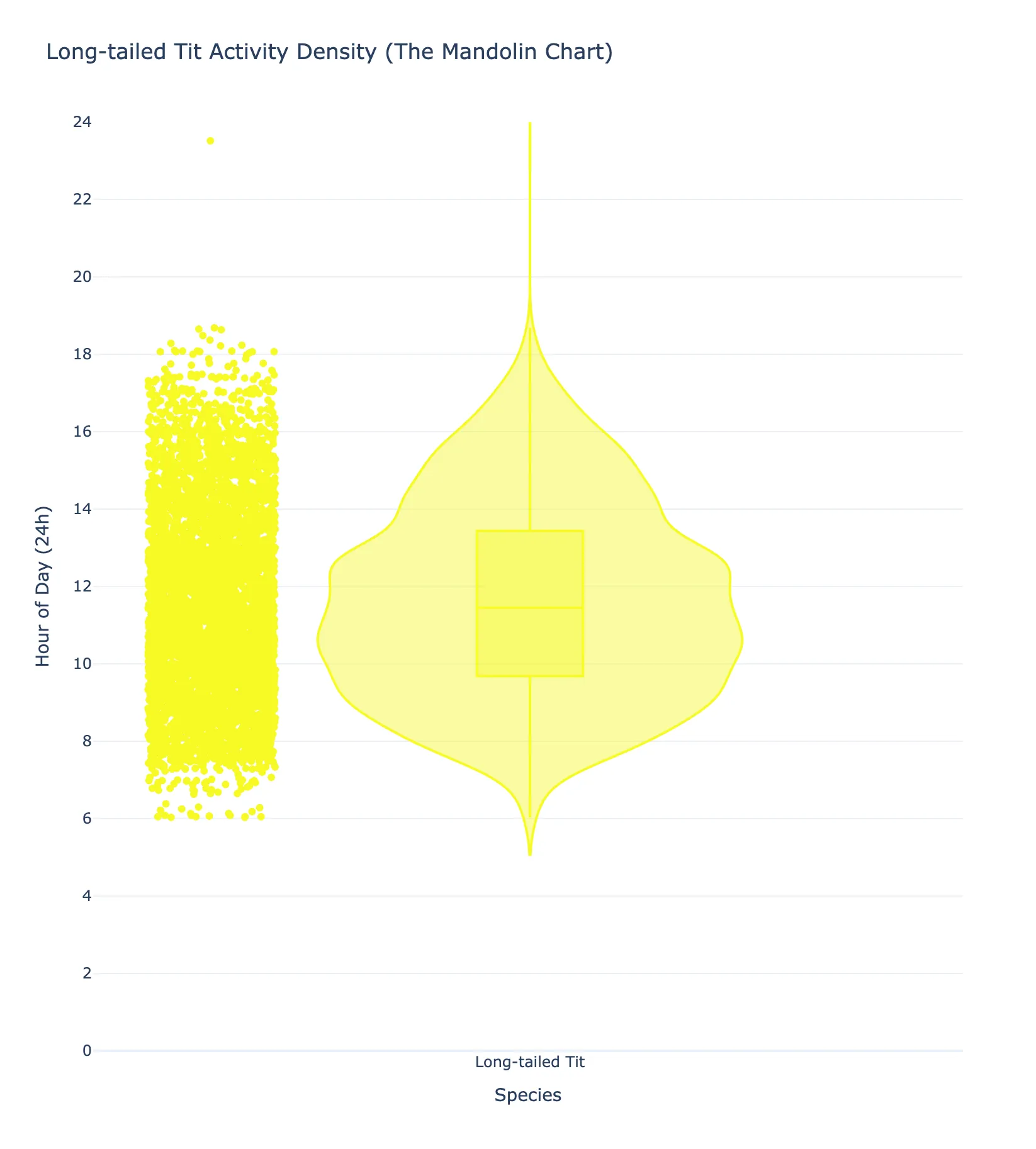
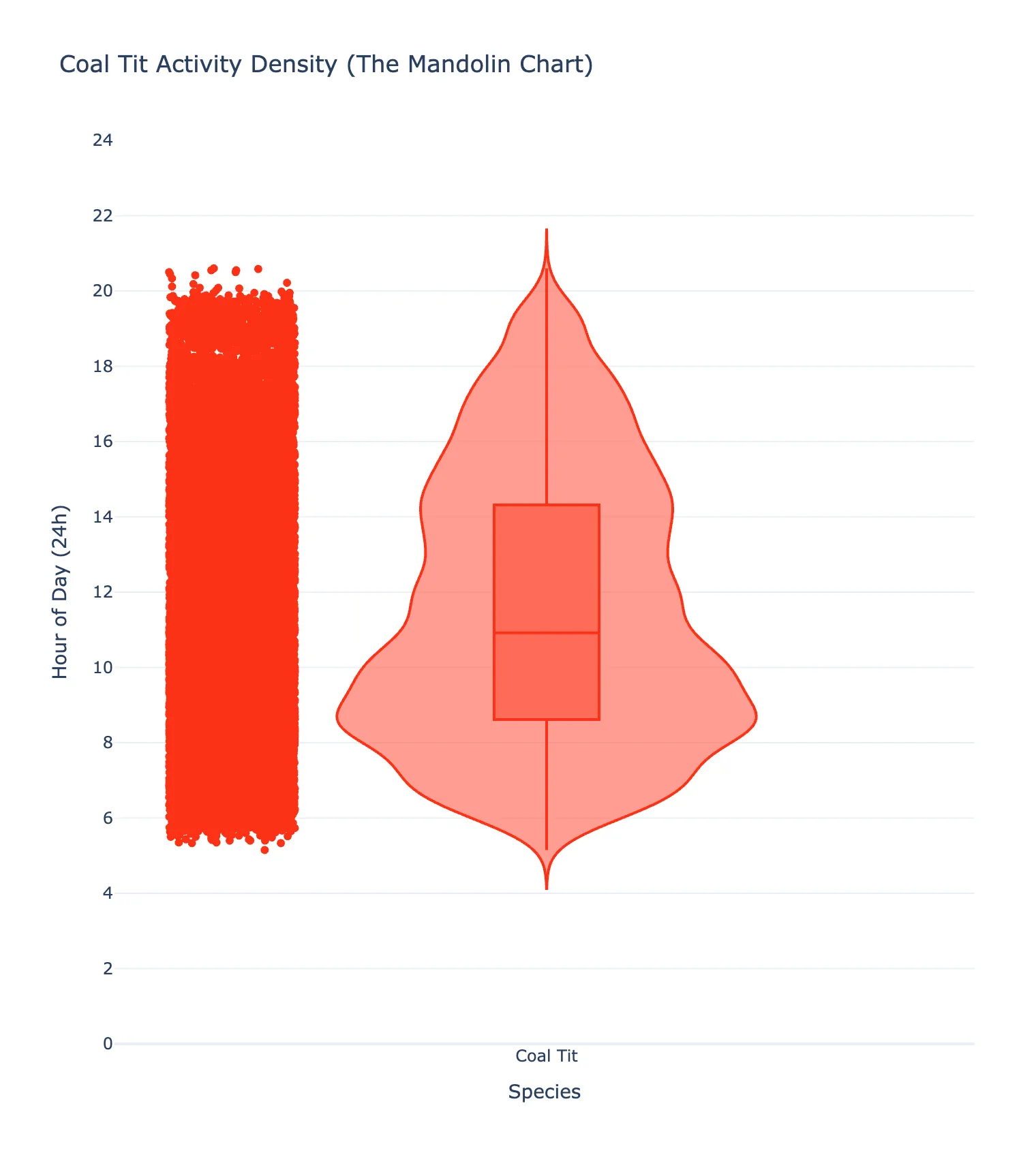
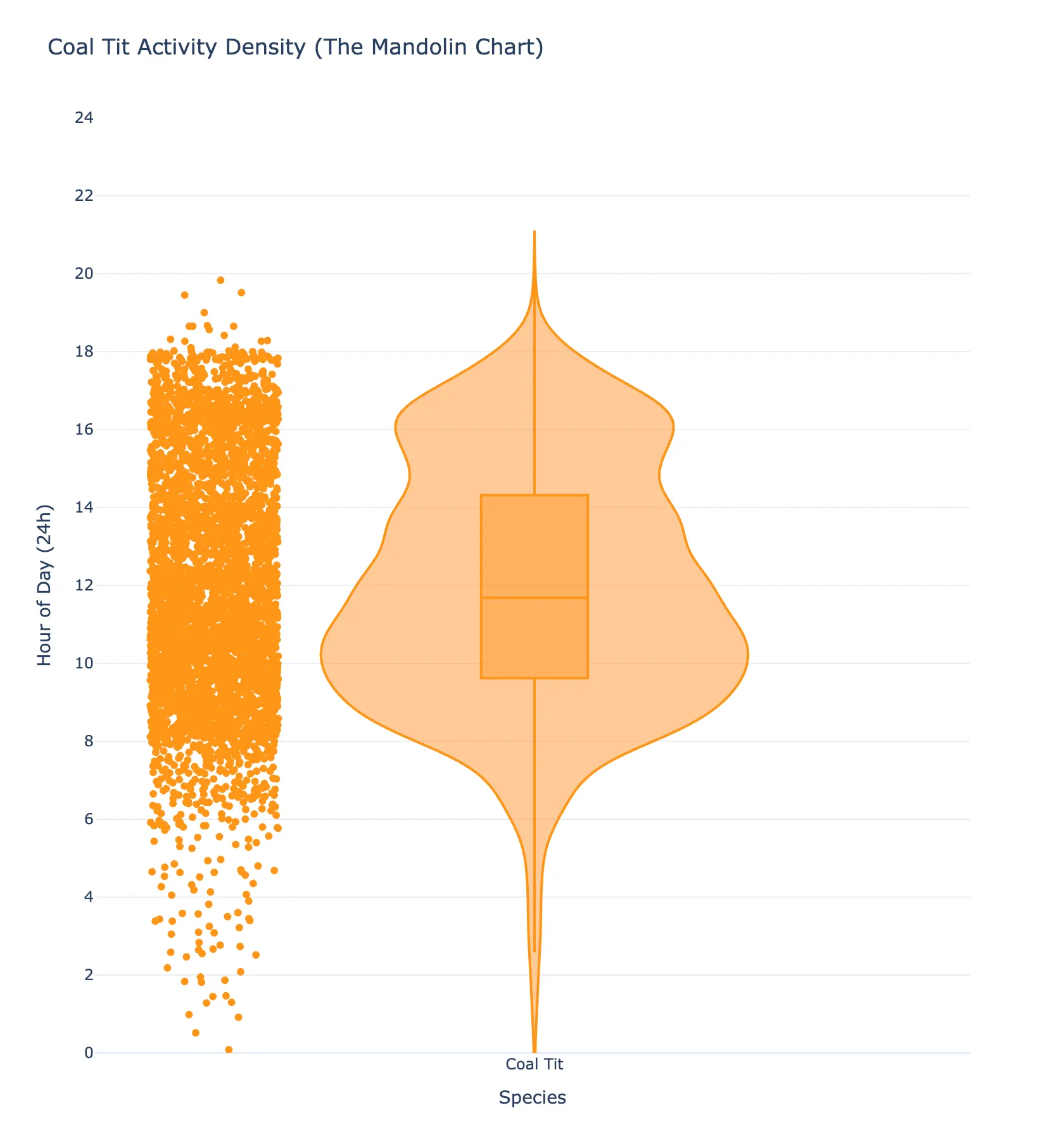
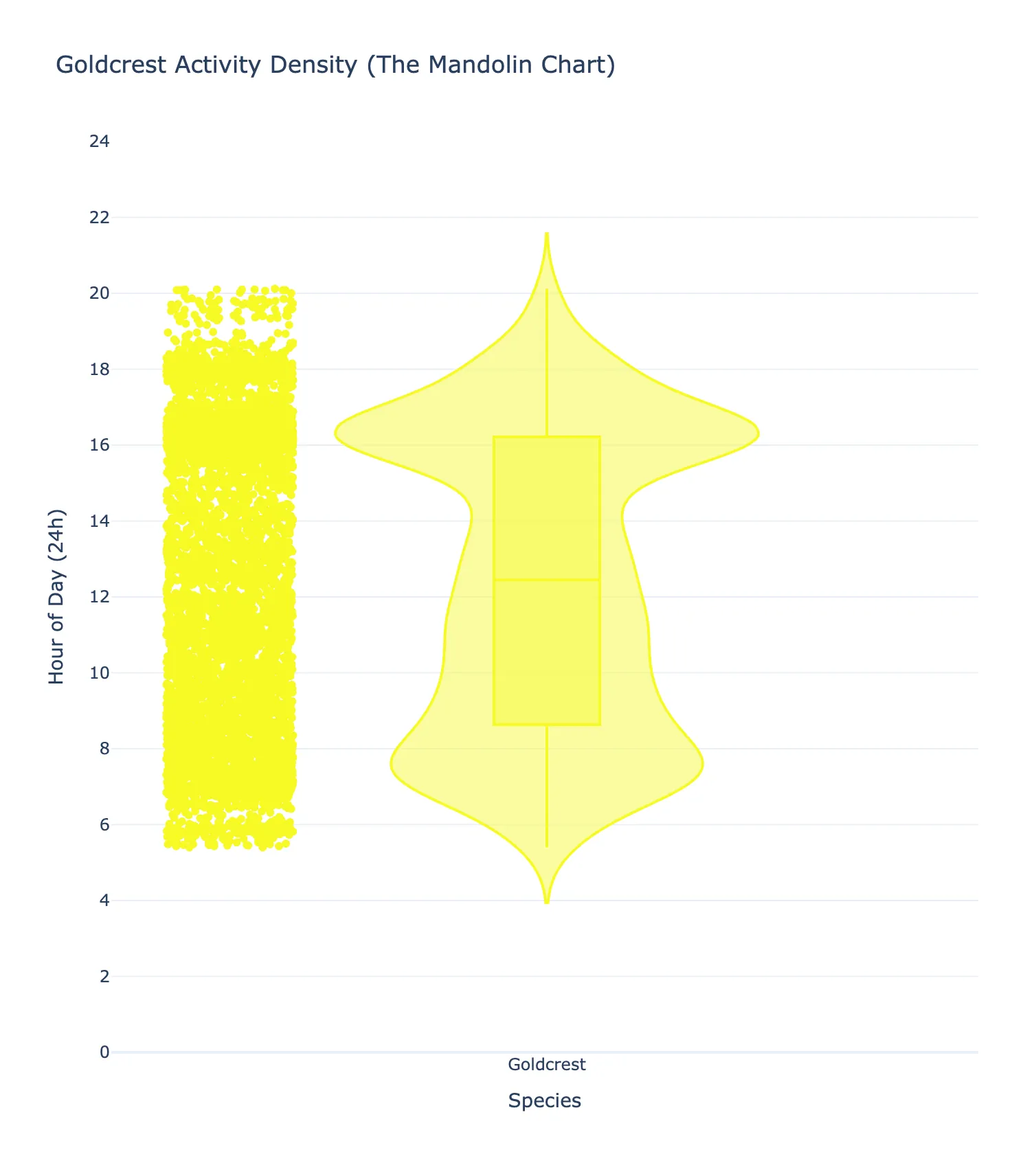
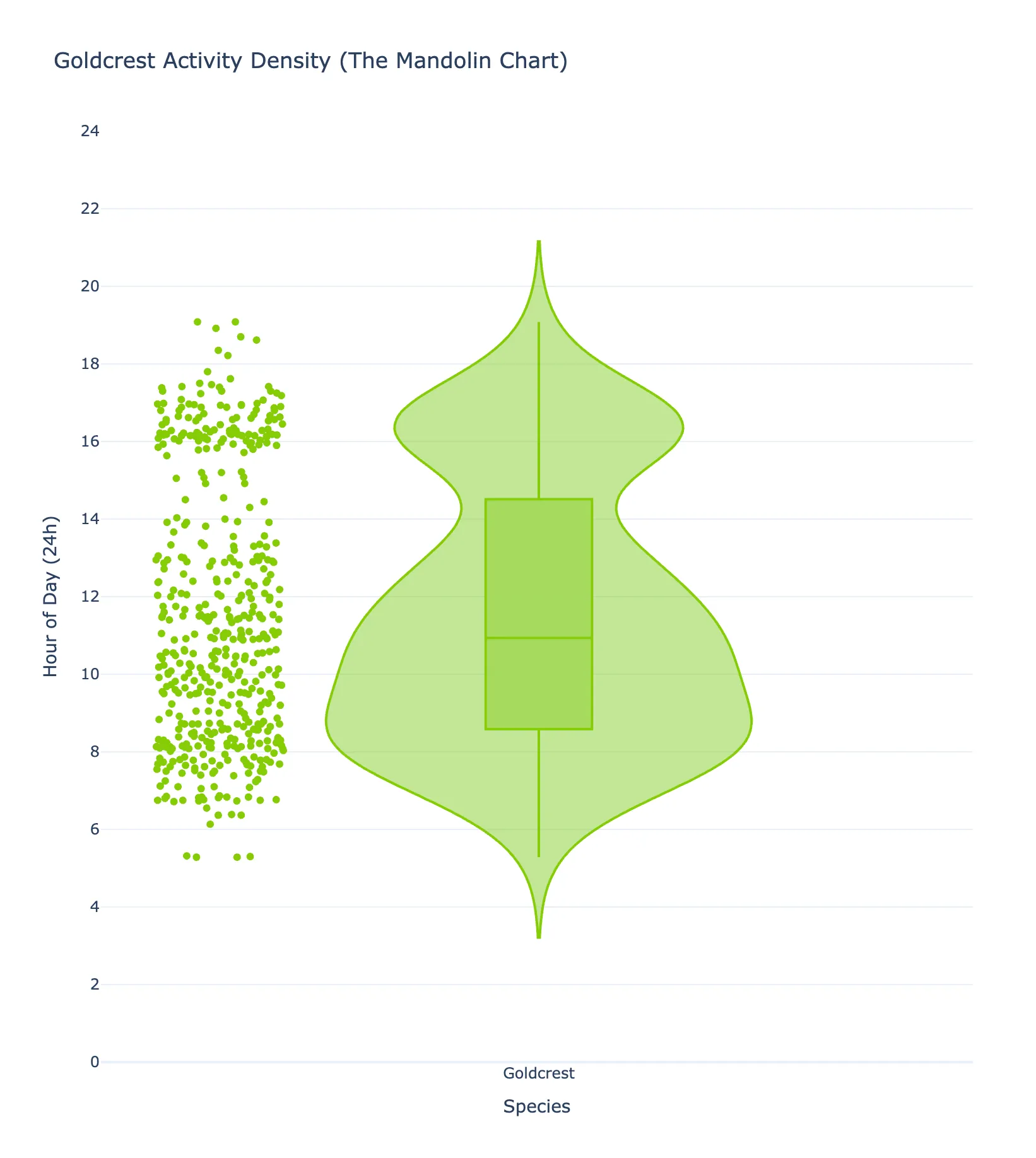
On a more positive note, there are a number of species that don’t seem to be affected by the light and noise we create. The Dunnock, Blue Tit, Long-tailed Tit, Goldfinch, Coal Tit, and Goldcrest all look largely similar between sites.
This makes ecological sense. Tits, dunnocks and goldcrests communicate mostly through short-range contact calls to stay in touch with flockmates, rather than long-range territorial broadcasts. Because they aren’t trying to project song across a noisy soundscape, there’s far less pressure to retime around traffic or streetlights.
Seeing no major shift in these species is itself a useful negative result- it suggests the differences in the other species are real biological signals rather than artefacts of the recording setup or BirdNET’s detection behaviour.
Dunnock
European Goldfinch
Eurasian Blue Tit
Long-tailed Tit
Coal Tit
Goldcrest
Do our results fit the norm?
Broadly, what we’re seeing aligns well with the published literature on urban bird ecology. The main signatures of urbanisation on bird activity are:
- Earlier dawn song
- Bimodal dawn/dusk activity (avoiding the noisy midday)
- Extended evening/nocturnal activity, especially in robins and thrushes
- More nocturnal flight calls from migrants
- Generalists and edge-feeders adapting more than woodland specialists
Our charts mirror all of these academic trends. The one exception is the wren, where our data sits outside what the literature would predict- exactly the kind of anomaly that makes long-term passive acoustic monitoring worth doing.
Overall, the patterns at our urban site suggest that city birds are shifting their schedules drastically, and, in some cases, barely sleeping. Urbanisation stretches the active window of the day, pushing song earlier into the morning, extending it later into the evening, and pulling nocturnal migrants down and out of the sky. Whether that reads as adaptation or disruption depends on the species. Even for adapters like the robin, a nocturnal workaround comes with a price. Singing through the night is metabolically expensive, and studies consistently show that chronic light and noise disruption leads to measurable physiological stress. The workaround, it seems, carries a steep biological tax.
Granted, this data represents a localised snapshot from just two monitors rather than a wide-scale controlled study, so our conclusions remain necessarily modest. But it is reassuring from a methodological standpoint that our small dataset so closely mirrors the broader academic literature, even if the ecological reality it highlights is a little sobering. As we continue collecting data and expanding our network of monitors, we hope these acoustic patterns will help us not only understand urban ecosystems, but eventually assist in designing the smarter, quieter city spaces these birds need to thrive.
[1] Da Silva, A., Valcu, M., & Kempenaers, B. (2015). Light pollution alters the phenology of dawn and dusk singing in common European songbirds. Philosophical Transactions of the Royal Society B: Biological Sciences, 370(1667), 20140126.
[2] Nordt, A., & Klenke, R. (2013). Sleepless in town – drivers of the temporal shift in dawn song in urban European blackbirds. PLOS ONE, 8(8), e71476.
[3] Fuller, R. A., Warren, P. H., & Gaston, K. J. (2007). Daytime noise predicts nocturnal singing in urban robins. Biology Letters, 3(4), 368–370.